Yogyakarta, January 20, 2026 — The Department of Agricultural and Biosystems Engineering (DTPB), Faculty of Agricultural Technology, Universitas Gadjah Mada (FTP UGM), continues to strengthen the quality of education and global insight of its postgraduate students through international academic activities. One of these efforts was realized through an international guest lecture featuring a distinguished scholar from abroad.
International Guest Lecture with Chungnam National University
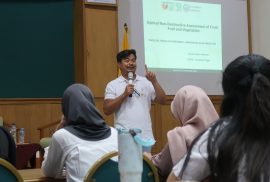
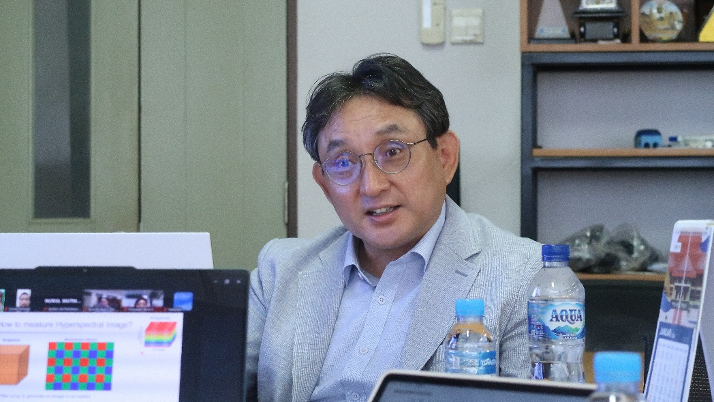
On this occasion, DTPB FTP UGM invited Prof. Byoung Kwan Cho from the Department of Biosystems Machinery Engineering, Chungnam National University, South Korea, who delivered a lecture entitled “Principles of NIR Spectroscopy for Non-Destructive Quality Evaluation in Food and Agricultural Products.”
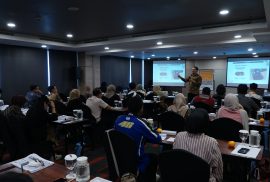
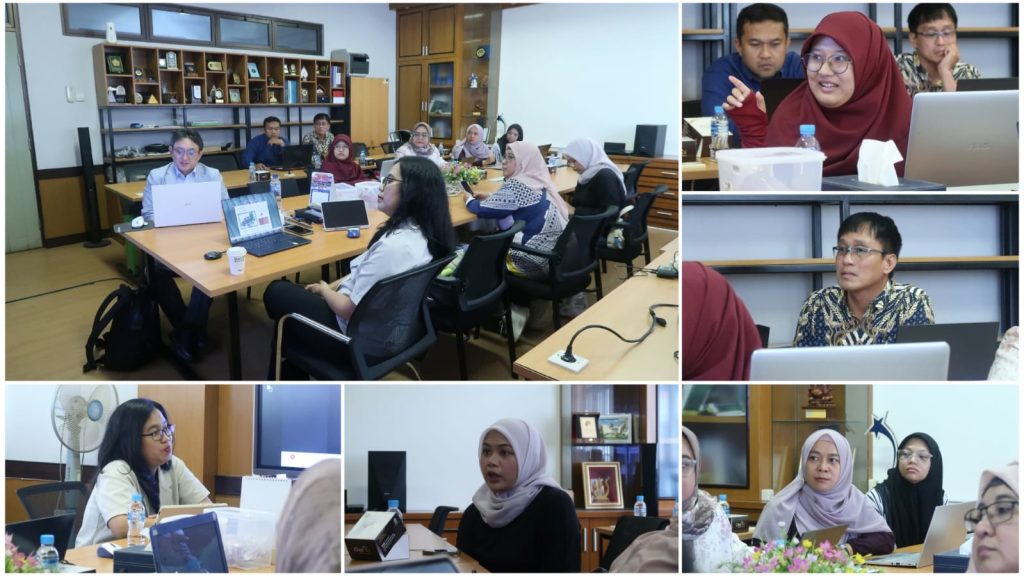
The guest lecture was conducted in a hybrid format at Meeting Room I, DTPB FTP UGM, and was attended by postgraduate students both on-site and online. The session was moderated by Dr. Rudiati Evi Masithoh, with Hanim Zuhrotul Amanah, Ph.D. also in attendance.
Overview of NIR Spectroscopy and Hyperspectral Imaging Principles
During his presentation, Prof. Cho explained the fundamental principles of Near Infrared (NIR) Spectroscopy and the development of hyperspectral imaging as a non-destructive method for evaluating the quality of food and agricultural products. This technology integrates spatial and spectral information simultaneously, enabling more comprehensive quality assessment.
“Hyperspectral imaging technology allows deeper identification of food and agricultural product quality, including characteristics that cannot be easily observed through conventional visual inspection, without damaging the product,” stated Prof. Cho.
Applications for Efficiency in Food and Agricultural Industries
Prof. Cho further elaborated on various applications of hyperspectral imaging in agriculture and food industries, ranging from crop quality monitoring to real-time quality control of food products. According to him, this non-destructive approach offers significant efficiency advantages.
“Through non-destructive approaches such as NIR spectroscopy, quality evaluation processes can be carried out quickly, efficiently, and accurately, making them highly relevant to the needs of modern food industries,” he explained.
At the end of his presentation, Prof. Cho highlighted the increasing global demand for safe and high-quality food, which continues to push industries to operate more rapidly and efficiently.
“The growing demand for safe and high-quality food will pressure industries to move faster and more efficiently. Hyperspectral imaging technology has strong potential to become increasingly popular in the future, as it can be applied directly on-site and effectively supports industrial needs,” he concluded.
Alignment with the Sustainable Development Goals (SDGs)
This international guest lecture aligns with DTPB FTP UGM’s commitment to supporting the Sustainable Development Goals (SDGs). The activity directly contributes to SDG 4 (Quality Education) by enhancing learning experiences through exposure to cutting-edge scientific knowledge and international academic collaboration.
Furthermore, the introduction of NIR spectroscopy and hyperspectral imaging technologies supports SDG 9 (Industry, Innovation, and Infrastructure) by promoting technological innovation in the agricultural and food sectors. The application of non-destructive quality evaluation methods is also in line with SDG 12 (Responsible Consumption and Production), as it contributes to process efficiency, waste reduction, and improved product quality.
In addition, the involvement of an international academic partner from Chungnam National University reflects the implementation of SDG 17 (Partnerships for the Goals) through strengthened global academic networks in education, research, and technological development.
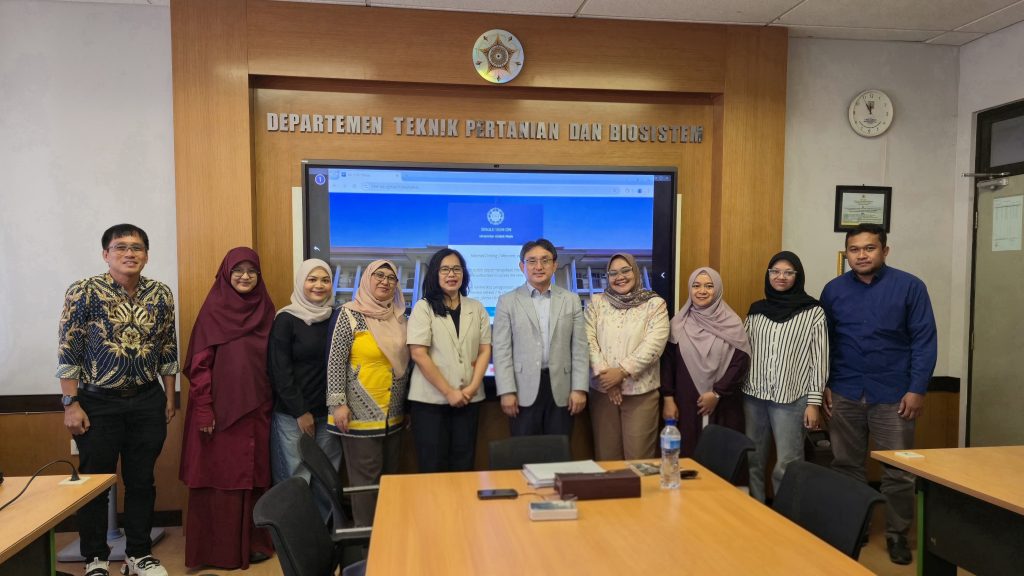
Through this activity, DTPB FTP UGM expects postgraduate students to gain not only advanced technical knowledge but also a broader global perspective and a stronger awareness of the role of science and innovation in achieving sustainable development.