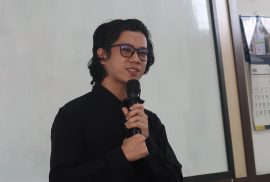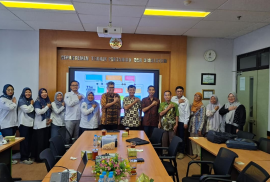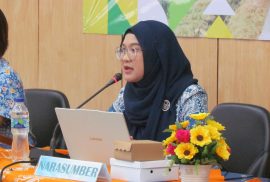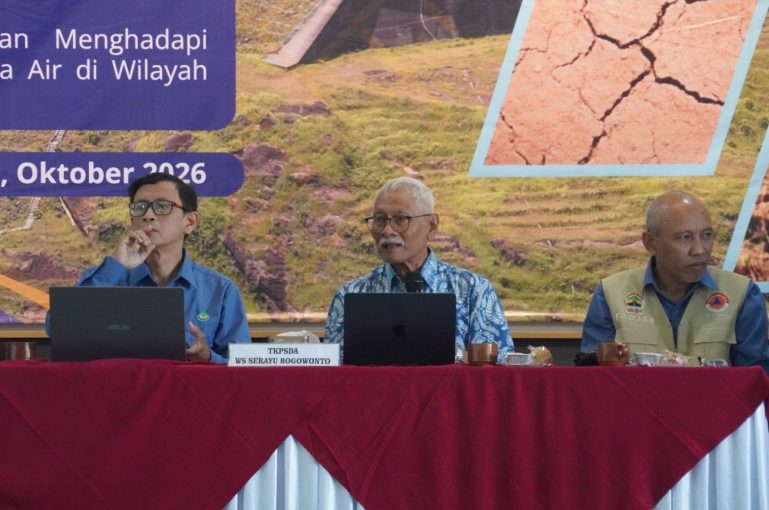
WONOSOBO – Facing the threat of drought at the end of the dry season and preparing for the transition of the hydrometeorological season, the Water Resources Management Coordination Team of the Serayu Bogowonto River Basin (TKPSDA WS Serayu Bogowonto) held its Commission II Session at Dewani View Resto & Cafe, Wonosobo, on Tuesday (10/20/2026). The strategic forum, themed “Drought Mitigation and Flood Preparedness in Water Resources Management in WS Serayu Bogowonto,” featured Professor at the Faculty of Agricultural Technology, Universitas Gadjah Mada (FAT UGM), and Expert at the Center for Irrigation and Agricultural Modernization Studies FAT UGM, Prof. Dr. Ir. Sigit Supadmo, M.Eng., as the main keynote speaker.
During the session, attended by cross-sectoral stakeholders, government agencies, and Irrigation Commission representatives, Prof. Sigit Supadmo presented key material titled “Water-Saving Agricultural Strategies and Technologies for Drought Mitigation.” He emphasized the importance of shifting the irrigation management paradigm from mere physical water conveyance techniques to a holistic approach rooted in culture, equitable allocation, and climate change adaptation.
Irrigation as a National Identity and the Importance of Equitable Allocation
Opening his presentation, Prof. Sigit asserted that irrigated agricultural culture in Indonesia has a long historical track record and forms an integral part of the nation’s identity in tropical monsoon regions. However, amidst limited water resources and growing demands from other sectors, the share of water allocated for irrigation—which currently consumes around 70% to 80% of total water resource management—must be managed far more efficiently and productively.
“Conceptually, irrigation management in river basins is an effort to enhance agricultural productivity using limited water resources based on equity, climate change adaptability, and sustainability,” Prof. Sigit stated.
He outlined 7 Main Execution Strategies for Water Management at the River Basin Level:
-
Building a Transparent Water Balance: Leveraging Data Engineering and Data Science to integrate availability, demand, water quality, and seasonal variation data.
-
Setting Equitable Water Allocation Priorities: Ensuring basic public needs, food security, and ecosystems through mutually agreed allocation rules.
-
Upstream to Downstream Management: Linking watershed conservation, dams, irrigation networks, and river ecosystem protection.
-
Increasing Water Productivity: Focusing on value creation and crop yields per unit of water, rather than sole technical channel efficiency.
-
Strengthening Participation, Institutional Capacity, and Culture: Engaging farmers (P3A/GP3A/IP3A) and coordinating bodies (KOMIR, TKPSDA) right from the planning stage.
-
Building Climate Change Resilience: Adjusting Global Planting Schedules (RTTG) and Detailed Planting Schedules (RTTD) based on climate scenarios.
-
Measuring Outcomes and Evaluating Policies: Assessing success against institutional sustainability, ecological health, and farmer welfare indicators.
Developing a “Water-Wise” Culture and Water-Saving Technologies
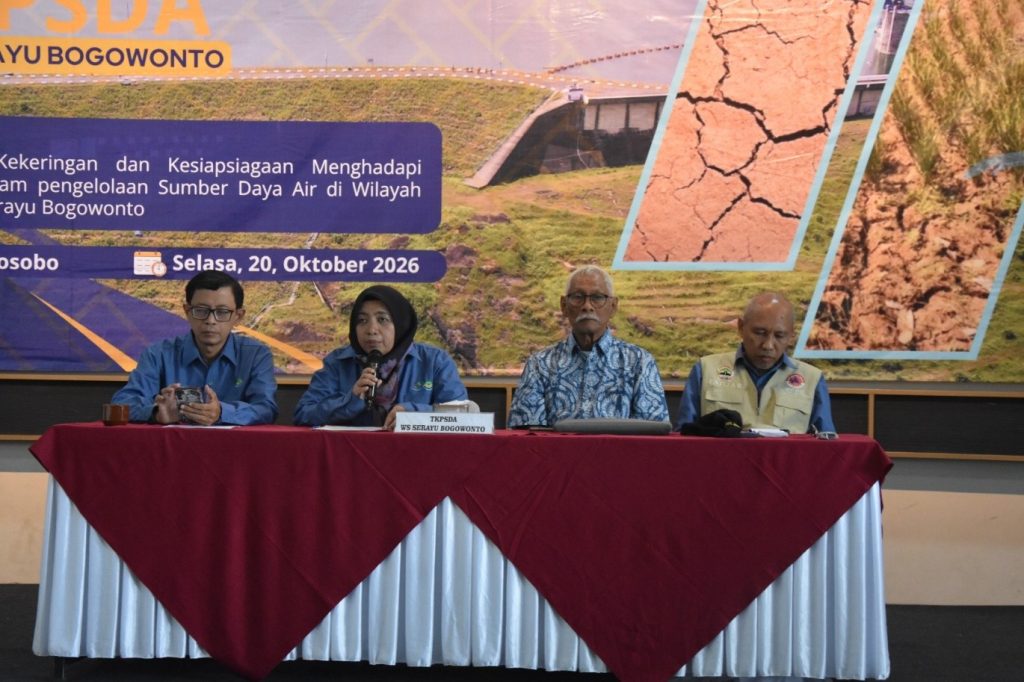
A central highlight presented by Prof. Sigit Supadmo was the vital need to revive a “Water-Wise Culture” (Budaya Arif Air) and a “Water-Saving Culture” (Budaya Hemat Air). According to him, being “water-wise” means treating and respecting water wisely, prudently, and knowledgeably across all aspects of public life.
In practical agricultural implementation, Prof. Sigit advocated for combining eco-friendly cultivation systems and technologies, including:
-
System of Rice Intensification (SRI) & Integrated Cropping Pattern (PTT) Methods: Optimizing rice growth without continuous land flooding.
-
Micro-Irrigation Development: Implementing drip and sprinkler irrigation for horticulture and agro-ecotourism.
-
Drought-Tolerant Varieties: Selecting rice and secondary crop seeds adaptable to water stress.
-
Clean Irrigation Movement (GIB): Mobilizing village communities and farmers to maintain the cleanliness and hydrological function of irrigation channels.
Critical Analysis of Pumping Efforts and Groundwater Use
Addressing the widespread practice of pumping during drought conditions, Prof. Sigit Supadmo offered a comprehensive critical review regarding both surface water and groundwater utilization. He issued specific affirmations regarding the boundaries and foundational principles of pump usage:
-
Prohibition of Pumping in Irrigation Networks: Prof. Sigit strongly underlined that water pumping must not be conducted inside irrigation networks, as it disrupts orderly water allocation systems, interferes with water distribution rights among farmers, and risks triggering social conflict at the Water User Association (P3A) level.
-
Surface Water Pumps (Rivers): Surface water extraction using pumps must be carefully evaluated based on the dependable river flow during the dry season, downstream user requirements, and environmental flow maintenance limits—not merely on the technical capacity of the pump engine.
-
Groundwater Pumps: Pose significantly higher ecological risks, including static groundwater table drawdown, drying up of community wells, and land subsidence. Extraction must be backed by hydrogeological feasibility tests (pumping tests), aquifer recovery monitoring, and compliance with the latest licensing regulations (Ministerial Regulation of Energy and Mineral Resources No. 4 of 2026 and Government Regulation No. 30 of 2024).
Cross-Sectoral Synergy for Water Resources Resilience
Through the academic expertise and strategic insights presented by Prof. Sigit Supadmo, the formulation of Minutes and Commission Session Recommendations (Water Resources Conservation Commission, Water Resources Utilization Commission, and Water Destructive Power Control Commission) is expected to provide concrete guidance for local governments and river basin managers in sustaining irrigation water supplies, protecting food security, and mitigating hydrometeorological disaster risks in WS Serayu Bogowonto.