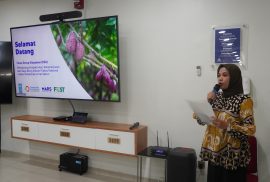
YOGYAKARTA – Amid the challenges of climate change, land conversion, and extensive damage to irrigation networks that threaten the reliability of water supply for the national agricultural sector, irrigation asset management in Indonesia demands a responsive and integrated governance transformation. Addressing these national irrigation challenges, Lecturer at the Department of Agricultural and Biosystems Engineering (ABE), Faculty of Agricultural Technology (FAT), Universitas Gadjah Mada (UGM), who also serves as Head of the Center for Irrigation and Agricultural Modernization Studies FAT UGM, Dr.Eng. Ansita Gupitakingkin Pradipta, S.T., M.Eng., served as the main speaker at the 3rd Session of the Yogyakarta Special Region (DIY) Irrigation Commission at Meeting Room A, DIY Public Works, Housing, and Energy & Mineral Resources Office, on Thursday (10/15/2026). In this strategic forum, she delivered a presentation titled “Building Responsive Irrigation Asset Management Through Stakeholder Evaluation and Collaboration.”
Measuring Irrigation Success Through Reliable Water Delivery to Farmers
In her presentation, Dr. Ansita emphasized that the ultimate benchmark of success in irrigation asset management is not merely measured by the physical condition of the network, but by the reliability of water services reaching farmers’ plots in a manner that is “Sufficient, Equitable, Reliable, and Flexible” (CAAL). Ideal irrigation asset management must encompass a continuous cycle, starting from network data inventory, service level planning, physical and non-physical implementation, and periodic evaluation, to transparent data updating.

“Irrigation asset management must be able to act responsively. When disruptions or damages occur in the field, managers must quickly identify the problem, designate responsible parties, and ensure network functions are restored so that water supply to farmers remains uninterrupted,” Dr. Ansita stated.
Importance of Data Integration, Service-Based Priorities, and P3A Synergy
Furthermore, Dr. Ansita highlighted the active involvement of Water User Associations (P3A, GP3A, and IP3A) in network inspections and setting repair priorities. Determining asset management priorities should not solely rely on the level of physical damage, but must also consider the asset’s position within the network and the total affected agricultural area.

This comprehensive evaluation and integrated asset governance serve as a crucial stage toward realizing irrigation modernization in the Special Region of Yogyakarta. To support the sustainability and modernization of the irrigation system, Dr. Ansita presented five key recommendations:
-
Asset Data Updating: Periodic verification of physical condition, functionality, and service areas integrated with the P3A tertiary network.
-
Service-Oriented Prioritization: Establishing repair priorities based on their impact on total irrigation service area.
-
Collaboration with Clear Follow-up Actions: Clarifying the roles and responsibilities of each stakeholder through the DIY Irrigation Commission forum.
-
Operation and Maintenance (O&M) Readiness: Ensuring the readiness of officers, procedures, and post-repair funding.
-
Continuous Evaluation: Utilizing annual evaluation reports as the baseline for budget planning and policy-making for the subsequent period.
Through this academic presentation and recommendations, the Department of Agricultural and Biosystems Engineering FAT UGM, through the Center for Irrigation and Agricultural Modernization Studies, reinforces its expertise in guiding equitable irrigation modernization.
 This academic contribution aligns with UGM’s global commitment to achieving the Sustainable Development Goals (SDGs), particularly SDG 2: Zero Hunger (empowering food sovereignty through resilient agricultural irrigation systems), SDG 6: Clean Water and Sanitation (promoting efficient management and integrated water resources governance), SDG 9: Industry, Innovation, and Infrastructure (modernizing reliable irrigation infrastructure based on data evaluation), and SDG 17: Partnerships for the Goals through synergy among the DIY Irrigation Commission, academics, technical agencies, and Water User Associations (P3A).