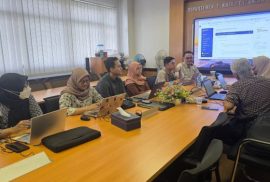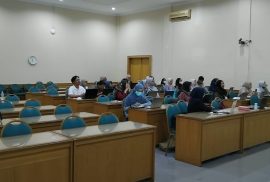
Gunungkidul, June 22, 2026 – Limited water resources due to the karst landscape and inadequate equipment for organic fertilizer production remain major challenges for farmers in Gombang Village, Ponjong District, Gunungkidul Regency. Most farmers still rely on rainfed agriculture, allowing them to harvest rice only once a year. To address these challenges, the Community Service Team from the Department of Agricultural and Biosystems Engineering (DTPB), Faculty of Agricultural Technology, Universitas Gadjah Mada (FTP UGM), organized a community engagement program entitled “Utilization of Mechanical Technology in Livestock Waste-Based Compost Production to Support Sustainable Agricultural Systems.”
The program served as a platform for technology transfer and discussions with local communities on organic fertilizer management, composting technologies, and water resource management to support more productive and sustainable dryland agriculture.

In his opening remarks, Dr. Arifin Dwi Saputro, S.T.P., M.Sc., Head of DTPB FTP UGM, expressed his appreciation for the warm welcome from the village government and the local community. He explained that community service is an integral part of the university’s Tri Dharma, aiming to provide tangible benefits to society.
“We sincerely appreciate the warm reception from the village government and the community. We hope this activity will become a forum for discussion where we can jointly identify the best solutions to the challenges faced by the community,” he said.
The event was officially opened by Dr. Joko Nugroho Wahyu Kariyadi, who introduced the community service team consisting of Dr. Arifin Dwi Saputro and several lecturers from various fields of expertise.
Representing the village government, Giyarto, Secretary of Gombang Village, expressed his gratitude for the program and emphasized the importance of knowledge transfer to improve agricultural efficiency and productivity.
“We hope the community service team can share knowledge with us and our residents to improve the efficiency and productivity of our agricultural activities,” he stated.
He explained that the village’s karst topography forces farmers to depend heavily on rainfed agriculture.
“Our agriculture relies solely on rainfall because our area is surrounded by karst landscapes, which means we can only harvest rice once a year. We also want to learn from UGM how our village can become more independent in securing its own water resources,” he added.
Satiman, Head of the Farmers Group, highlighted another challenge faced by farmers: limited equipment for organic fertilizer production.
“We hope that the knowledge and collaboration with UGM will improve our agricultural productivity as well as our organic fertilizer production. We also hope this collaboration will continue and expand to other sectors,” he said.

During the technical sessions, Dr. Joko Nugroho Wahyu Kariyadi presented composting technologies and discussed key factors determining compost production success. He emphasized that temperature is one of the most important parameters to be controlled during the decomposition process. He also introduced compost quality standards adopted in several countries as references for producing high-quality compost.
The next session was delivered by Dr. Andri Prima Nugroho, who introduced the application of LoRa technology in compost production.
“The secret to successful composting lies in three factors: temperature, humidity, and pH,” he explained.
According to Dr. Andri, large-scale compost production requires significant effort because farmers must regularly monitor temperature and turn heavy compost piles.
“The idea behind this technology is to develop a system capable of stirring compost while simultaneously measuring temperature, humidity, and pH, and then sending the data directly to users so they can make appropriate decisions during the composting process,” he explained.
Dr. Andri and Samuel also demonstrated a temperature and humidity monitoring device that enables real-time observation of compost conditions.
Meanwhile, Dr. Ir. Murtiningrum presented a session on groundwater and aquifer management in rainfed agricultural areas. She highlighted challenges related to water scarcity, groundwater pumping, and the risk of overpumping.
“Water is a renewable resource, but only seemingly so, because groundwater recharge requires time. Therefore, its utilization must be managed wisely,” she explained.
She also encouraged villagers to consult experts before constructing deep wells to better understand local groundwater conditions. Additionally, she introduced mist irrigation technology as a more water-efficient alternative to conventional irrigation methods.
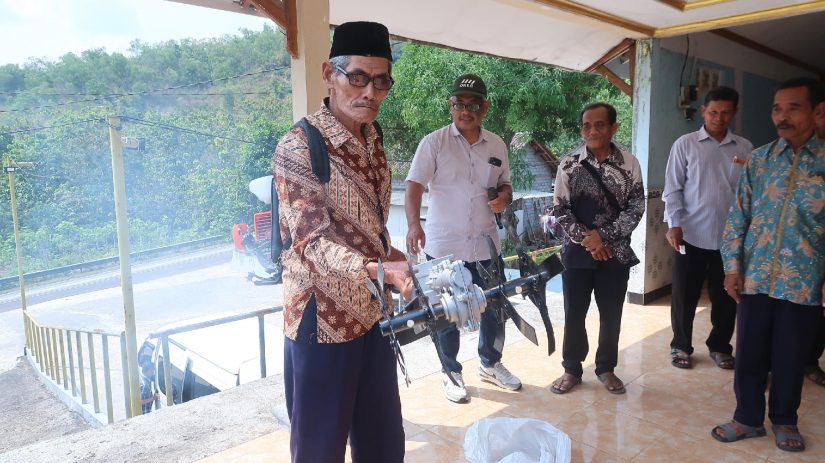
As part of the program, the FTP UGM community service team donated several tools to Gombang Village, including a grass-cutting machine, a compost-mixing attachment, and temperature and relative humidity sensors to support agricultural and composting activities.

Through this program, DTPB FTP UGM hopes that research and innovations developed at the university can provide tangible benefits to society, particularly in improving dryland agricultural productivity, strengthening village self-reliance, and promoting sustainable natural resource management in Gunungkidul.