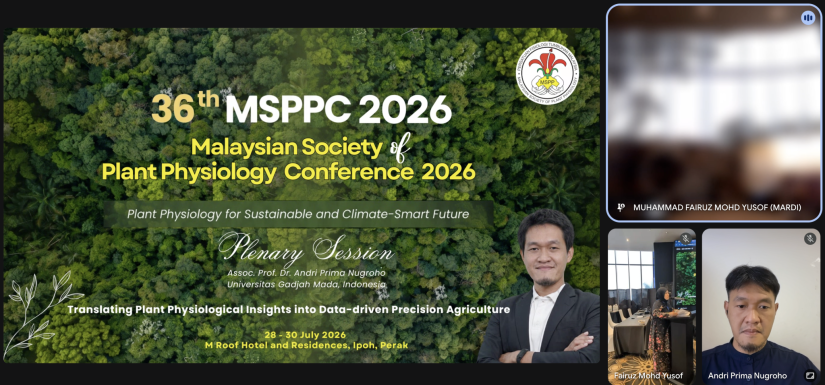
Ipoh, Malaysia, July 28, 2026 – The application of digital technologies in agriculture continues to create new opportunities to enhance productivity while strengthening the resilience of agricultural systems against climate change. Demonstrating its contribution to the advancement of agricultural science at the international level, Ir. Andri Prima Nugroho, S.T.P., M.Sc., Ph.D., IPU., ASEAN Eng., APEC Eng., a lecturer at the Department of Agricultural and Biosystems Engineering (DABE), Faculty of Agricultural Technology, Universitas Gadjah Mada (FTP UGM), was invited as a Plenary Speaker at The 36th Malaysian Society of Plant Physiology Conference (MSPPC 2026). His participation reinforced DABE FTP UGM’s role in advancing precision agriculture through the integration of plant physiology, remote sensing, and data analytics to support sustainable tropical agriculture.
Sharing Precision Agriculture Innovations at an International Forum
MSPPC 2026 was organized by the Malaysian Society of Plant Physiology (MSPP) from July 28–30, 2026, at M Roof Hotel, Ipoh, Perak, Malaysia, under the theme “Plant Physiology for Sustainable and Climate-Smart Future.” The conference brought together researchers, academics, industry practitioners, and policymakers from various countries to discuss recent advances in plant physiology and its role in addressing climate change while promoting sustainable agricultural systems.
During the conference, Dr. Andri delivered a plenary presentation entitled “Translating Plant Physiological Insights into Data-Driven Precision Agriculture.” The presentation was delivered in a hybrid format, beginning with a pre-recorded presentation followed by a live interactive discussion with conference participants.
Bridging Plant Physiology and Digital Technologies

In his presentation, Dr. Andri explained that plant physiological information serves as a fundamental basis for developing precision agriculture systems. Parameters such as leaf chlorophyll content, stomatal conductance, electron transport rate, and chlorophyll fluorescence provide valuable insights into plant physiological status and responses to environmental stress.
However, direct physiological measurements in the field are often constrained by time, specialized equipment, and the need for extensive sampling. Therefore, innovative approaches are required to translate point-based physiological measurements into comprehensive field-scale information.
Dr. Andri demonstrated how plant physiological data can be integrated with multispectral imagery acquired using unmanned aerial vehicles (UAVs) or drones. By applying data-driven modeling techniques, the integration of these datasets enables spatial mapping of crop conditions, thereby supporting more accurate and efficient agricultural decision-making.
Drone-Based Plant Health Monitoring: A Case Study