MERAUKE – Low coffee productivity, currently standing at only 560 grams of green beans per tree per year compared to the ideal potential of 1.5 kg per tree per year, poses a major challenge for farmers in the Muting Transmigration Area, Merauke Regency, South Papua. Addressing this issue, the UGM Patriot Expedition Team (TEP) 1, led by Faculty Member at the Department of Agricultural and Biosystems Engineering (DTPB) FAT UGM, Chandra Setyawan, S.T.P., M.Eng., Ph.D., intervened to strengthen Muting’s upstream coffee sector through cultivation support and Integrated Pest Management (IPM) training partnered with Musamus University (Unmus) Merauke.

Dr. Chandra emphasized that the Muting Transmigration Area possesses promising plantation potential, with coffee serving as a key driver of the local economy.
“Muting coffee holds immense potential for expansion because it has become an integral part of local farming activities and offers high economic value,” stated Chandra Setyawan.
Addressing PBKo Pests and Strengthening Soil-Water Conservation
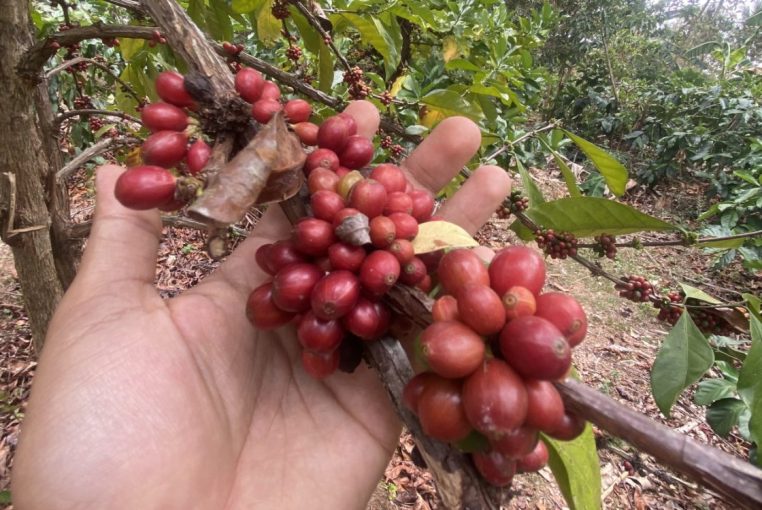
However, the significant yield gap highlights a critical need for upstream intervention, particularly in improving cultivation practices and pest management. One of the most severe threats identified is the Coffee Berry Borer (PBKo) or Hypothenemus hampei (Ferr.).
“PBKo pest infestation not only risks reducing crop quantity but also degrades the physical and intrinsic quality of coffee beans. Therefore, proper intervention from the upstream sector is imperative,” Chandra explained.
Specifically, Dr. Chandra’a scientific expertise is directed toward bolstering upstream cultivation by applying soil and water conservation techniques to enhance soil quality and carrying capacity. Improving soil health and water conservation serves as a vital foundation for optimizing crop growth and resilience against environmental stresses for coffee and intercropped commodities like cacao.
Innovation and Sustainable Mentorship
As a concrete step, the UGM team organized pest management training attended by approximately 80 farmers representing four farming groups in Seed Agung Village. Farmers were trained in routine crop monitoring, plantation sanitation, and mechanical/biological IPM practices. 
DTPB FAT UGM lecturer Moh. Wahyudin, S.T.P., M.Sc., Ph.D., who presented on business model design and coffee downstreaming roadmaps, added that economic value creation must begin with superior bean quality at the farm level. Additionally, UGM introduced FAPET POC organic liquid fertilizer, developed by the Faculty of Animal Science UGM, to enhance plant nutrition.
This assistance program highlights the academic expertise of DTPB FAT UGM faculty members in integrating agricultural engineering, soil and water conservation, and biosystems management to deliver applicable solutions for frontier community challenges. This initiative advances the Sustainable Development Goals (SDGs), particularly SDG 1: No Poverty, SDG 8: Decent Work and Economic Growth, SDG 10: Reduced Inequalities, and SDG 17: Partnerships for the Goals.