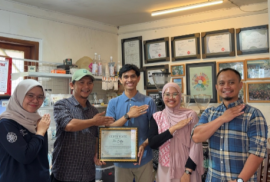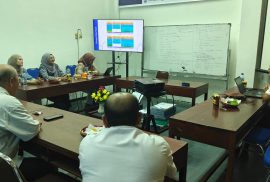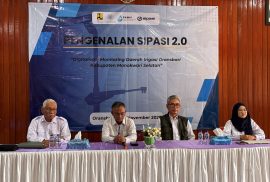
YOGYAKARTA — Amidst the massive wave of digital transformation and the disruption of Artificial Intelligence (AI) across global industries, the greatest challenge in the modern world is no longer the availability of advanced technology, but rather human capability to accurately map real-world case requirements. Addressing this urgency, the Department of Agricultural and Biosystems Engineering (DTPB), Faculty of Agricultural Technology (FAT), Universitas Gadjah Mada (UGM) held a strategic guest lecture themed “Edge Computing and Agentic AI Technologies for Agriculture” on Monday, November 16, 2026. The event featured a prominent expert from the Research Center for Smart Mechatronics at the National Research and Innovation Agency (BRIN), Dr. Muhtadan, to thoroughly explore how the integration of edge computing and autonomous AI systems can be proportionally applied to revolutionize precision agriculture practices in Indonesia.

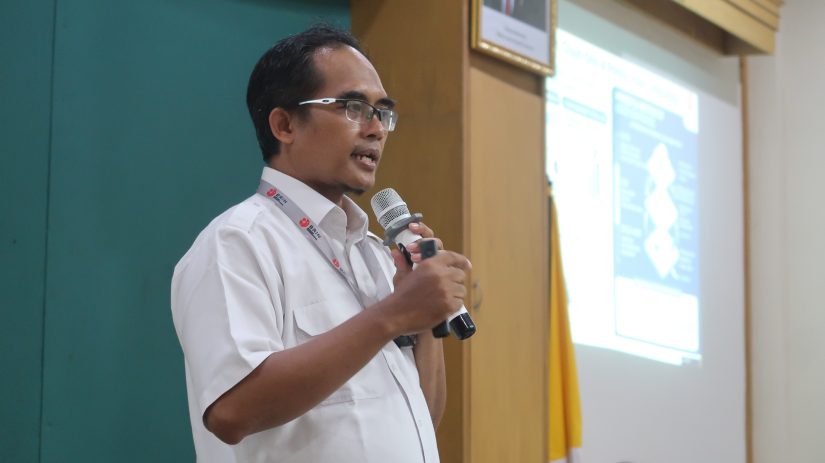
The guest lecture exploring intelligent systems was opened by Ardan Wiratmoko, S.T.P., M.Sc. as the master of ceremonies, followed by welcoming remarks from the Head of DTPB FAT UGM, Dr. Arifin Dwi Saputro, S.T.P., M.Sc., IPM., ASEAN Eng. Throughout the main session, the discussion was interactively moderated by Ir. Andri Prima Nugroho, S.T.P., M.Sc., Ph.D., IPU., ASEAN Eng., APEC Eng. During the session, Dr. Muhtadan delivered the keynote presentation titled “Edge Computing and Agentic AI Technologies for Agriculture”, discussing how the combination of edge computing and autonomous artificial intelligence (agentic AI) can revolutionize precision agriculture practices.
Exploring Edge Computing and AI Intelligence Levels
During his presentation, Dr. Muhtadan explained that implementing edge computing is crucial for overcoming connectivity constraints, bandwidth costs, and latency challenges frequently faced in Indonesia’s agricultural sector. He emphasized that cloud and edge technologies do not oppose one another, as each offers distinct advantages. According to him, system designers must establish a solid basis for mapping out when to rely on the cloud, when to utilize the edge, or when to integrate both simultaneously.
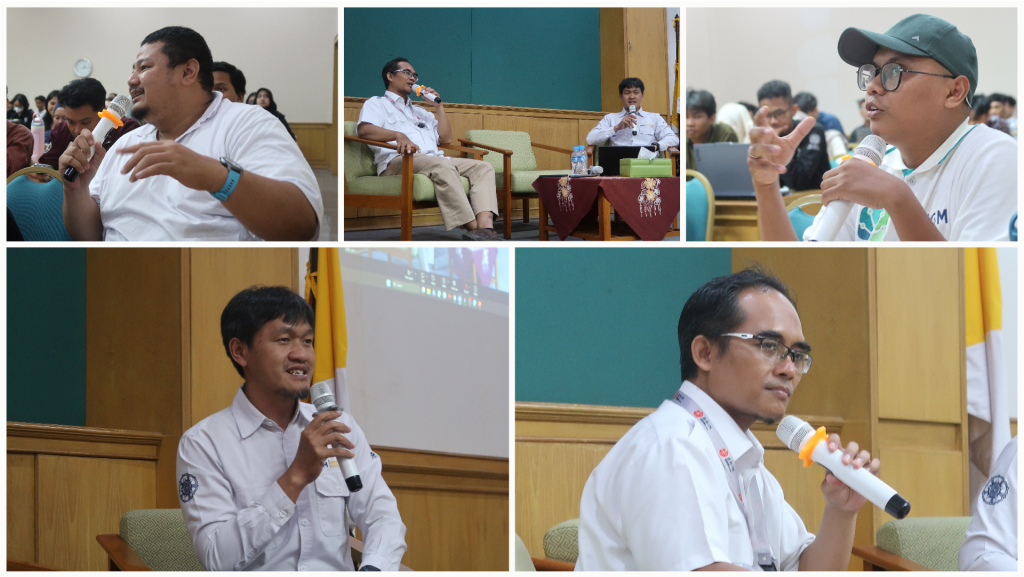
Furthermore, he discussed device task allocation in smart irrigation systems, AI intelligence tiers, and the application of agentic AI, which possesses higher autonomy compared to conventional AI. Summarizing the core principles of system implementation, Dr. Muhtadan stressed that artificial intelligence must be positioned according to its operational time scale—placing control functions directly at the device level, safety mechanisms at the edge layer, and advanced reasoning at the upper layer.
Towards the end of the guest lecture, Dr. Muhtadan delivered closing remarks summarizing key takeaways for students looking to study intelligent systems:
“First, intelligence follows a time scale—position it accordingly (control at the device, safety at the edge, reasoning at the top); second, authority must increase gradually once AI proves its capability; and third, test under worst-case scenarios, ensuring tests are conducted not just under normal conditions but also under measurable worst-case conditions,” Dr. Muhtadan stated in closing his primary material.
Reflective closing remarks were also delivered by moderator Ir. Andri Prima Nugroho, emphasizing that technology selection must align proportionally with real field requirements rather than mere trends:
“Your role here is to map out which technology fits your specific problem. Match the case correctly with the right technology so the solution truly addresses the challenge,” Ir. Andri Prima Nugroho concluded.
Contribution to Sustainable Development Goals (SDGs)

Through this event, students gained direct practical insights from a national research institution while supporting the United Nations Sustainable Development Goals (SDGs). This guest lecture directly contributes to SDG 4 (Quality Education) by enhancing students’ digital literacy through cutting-edge, research-based knowledge transfer, SDG 9 (Industry, Innovation, and Infrastructure) by promoting appropriate smart farming innovations powered by edge computing and AI, and SDG 17 (Partnerships for the Goals) by strengthening knowledge-transfer synergy between higher education (DTPB FAT UGM) and national research agencies (BRIN).