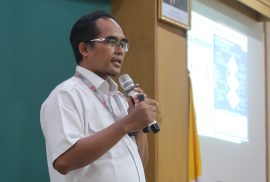
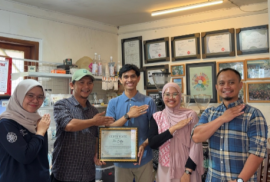
Bandar Lampung, November 13, 2026. Developing agricultural and food technologies needs to start from user problems and be supported by appropriate testing. This approach served as the direction of the material presented by Dr. Andri Prima Nugroho when acting as a speaker and mentor in the Hackathon DeepTech for FoodTech Indonesia 2026 organized by LPPM Universitas Muhammadiyah Metro at Hotel Emersia Bandar Lampung, Friday (13/11).
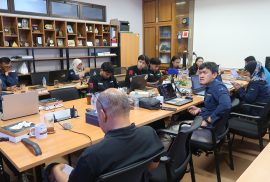
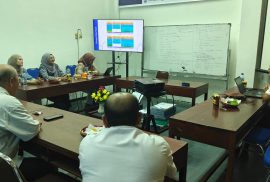
As a lecturer at DTPB FAT UGM and a researcher at the Smart Agriculture Research Center, Andri delivered the material titled “Developing Prototypes and Minimum Viable Products (MVP) for DeepTech for FoodTech Based on IoT, Sensors, and Smart Monitoring”, as well as directly mentoring the development of participants’ innovation ideas. The first mentoring session took place from 13:00–17:00 WIB involving 10 participant groups, where Andri joined Pipi Puspita Sari, Yeri Ehwan, and Agus Sutanto as a mentoring team to review designs, prototypes, technological readiness, and opportunities for solution implementation.
According to coverage by LPPM UM Metro, the first mentoring session took place from 13:00–17:00 WIB and was attended by 10 groups. Andri joined Pipi Puspita Sari, Yeri Ehwan, and Agus Sutanto as mentors. Participants presented their designs and prototypes to receive feedback regarding technological readiness and opportunities for implementation.
The material prepared for this event connects agricultural problems with solution design stages. Developers need to recognize users, understand decisions that must be made, and gather evidence regarding needs in the field. From those needs, teams can determine system functions, formulate requirements, and select an appropriate technology architecture.
Discussions on prototypes and MVPs were placed within the idea-testing process. Prototypes help developers examine parts of the design that are still uncertain. Meanwhile, determining minimum functions in an MVP helps teams focus development on the most important user needs. Testing is required to assess whether the design works according to requirements and whether users obtain the assistance needed.
Sensors, the Internet of Things (IoT), and monitoring systems serve as supporting tools in that workflow. Data collection needs to be linked to information that can be used to determine actions. Through this approach, technology selection has a clear basis in addressing agricultural and food problems.
As a bridge between concept and implementation, the presentation materials placed SIPASI for irrigation management and AURORA for smart fertigation as examples in the final section. Both examples were used to help explain the relationship between user needs, data, system functions, and evaluation.

Mentoring discussions covered issues closely tied to agricultural and food needs. For Emil.AI, which develops supply chain services and grain quality estimation, mentor feedback highlighted ease of adoption by farmers as well as connectivity with rice mills and harvest off-takers. Meanwhile, discussions on Smart Pellet, a smart livestock feed machine, covered operational safety, overheating risks, and the clarity of benefits from adding IoT technology. These examples demonstrate the importance of testing technology functions alongside user needs and usage conditions.


Mentoring discussions covered issues closely tied to agricultural and food needs. For Emil.AI, which develops supply chain services and grain quality estimation, mentor feedback highlighted ease of adoption by farmers as well as connectivity with rice mills and harvest off-takers. Meanwhile, discussions on Smart Pellet, a smart livestock feed machine, covered operational safety, overheating risks, and the clarity of benefits from adding IoT technology. These examples demonstrate the importance of testing technology functions alongside user needs and usage conditions.
The role of speakers and mentors in this event connects university research experience with participants’ innovation development processes. Such mentoring provides space for teams to review assumptions, prioritize functions, and prepare testing evidence before expanding product development.
This activity aligns with the Sustainable Development Goals (SDGs), particularly SDG 2: Zero Hunger, SDG 9: Industry, Innovation, and Infrastructure, and SDG 17: Partnerships for the Goals. The connection to SDG 2 lies in developing technological solutions to address agricultural and food issues. Mentoring in design, testing, and prototype refinement is relevant to SDG 9 through strengthening research-based innovation. Meanwhile, the gathering of universities, mentors, and innovator teams reflects the spirit of SDG 17 in building collaboration and knowledge exchange to develop solutions tailored to user needs.