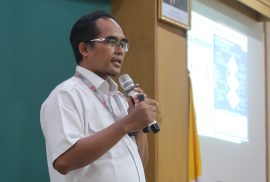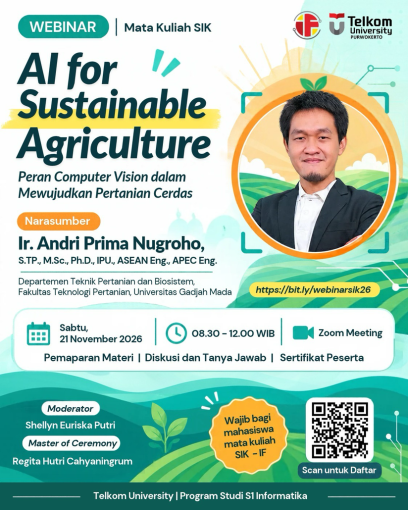
YOGYAKARTA — Utilizing artificial intelligence (AI) and computer vision to understand plant conditions was the central focus of the Socio-Informatics and Professionalism Webinar organized by the Undergraduate Informatics Engineering Study Program at Telkom University Purwokerto on Saturday, November 21, 2026. Held under the theme “AI for Sustainable Agriculture: The Role of Computer Vision in Realizing Smart Agriculture”, the event featured Ir. Andri Prima Nugroho, S.T.P., M.Sc., Ph.D., IPU., ASEAN Eng., APEC Eng., a lecturer at the Department of Agricultural and Biosystems Engineering (DTPB), Faculty of Agricultural Technology, Universitas Gadjah Mada (FAT UGM), as speaker.
Conducted online via Zoom Meeting with 225 participants, the webinar was opened by Nenen Isnaeni representing the Head of the Informatics Engineering Study Program. The forum provided an interdisciplinary learning space connecting informatics competencies with practical agricultural technology development needs.
From Tropical Agriculture Dynamics to Plant Thermal Imaging
In his presentation, Andri structured the material starting from the context of tropical agriculture and the interplay among water, plants, and the environment, before moving on to precision agriculture, smart farming, and fundamentals of image processing. This progression positioned an understanding of plant biological conditions as the foundation for designing data-driven observation and analysis systems.
One practical example highlighted in the session was the use of thermal imaging to study plant water status. This approach links temperature measurement, image processing, and environmental information with plant monitoring needs, helping participants grasp how device-recorded data relates to the physiological conditions of the observed crop.


Participant engagement was evident during the discussion session, which focused on field implementation challenges. Questions covered designing outdoor chili crop monitoring using an ESP32 camera connected to a mobile application—including operating challenges during the rainy season—as well as mapping environmental conditions, soil, and water availability.
Participants also inquired about the link between technology and plant physiology, including soil water availability, root uptake, water transport to leaves, and transpiration through stomata, alongside ensuring AI analysis aligns with plant biological states rather than computational metrics alone. System reliability questions—such as data transmission delays or sensor data loss in thermal imaging monitoring—as well as scoping research on strawberry disease detection in greenhouses from model building to IoT or robotics integration, also featured prominently, underscoring the need to align algorithm development with biosystems knowledge, hardware design, and data quality.
The webinar supports the Sustainable Development Goals (SDGs), particularly SDG 4 (Quality Education) through digital skill-building and sustainable technology literacy, SDG 9 (Industry, Innovation, and Infrastructure) by introducing AI, computer vision, and sensing for agricultural innovation, and thematic alignment with SDG 2 (Zero Hunger) through educational discussions on monitoring plant water status and cultivation environments to support sustainable agriculture.
Contributor : Andri Prima Nugroho