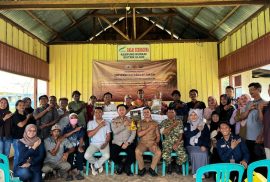
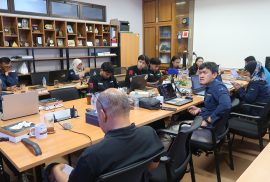
SELOPAMIORO — A Community Service Team focused on Appropriate Technology Implementation from the Department of Agricultural and Biosystems Engineering (DTPB), Faculty of Agricultural Technology (FAT), Universitas Gadjah Mada (UGM), held a Training and Mentoring Session on Pumpkin Drying Techniques using a Cabinet Dryer in Selopamioro Village, Imogiri District, Bantul Regency, on Monday, November 23, 2026. The activity is part of a community service program titled “Application of Processed Pumpkin Production Techniques for Economic Growth and Stunting Solutions in Selopamioro Village”, aiming to implement technology transfer to improve quality and diversify processed pumpkin products.
The program is led by Dr. Ir. Devi Yuni Susanti, S.T.P., M.Sc., IPU., ASEAN Eng., with team members Ngadisih, S.T.P., M.Sc., Ph.D., Hilda Maya Sintia Dewi, S.T.P., M.Sc., Dwi Ayuni, S.T.P., M.Sc., Ph.D., and Dr. Eng. Mohammad Kholid Ridwan, S.T., M.Sc.
Local Commodity Potential and Postharvest Diversification
Several farmer groups in Selopamioro Village cultivate pumpkins, which are mostly sold fresh. Local land conditions also offer potential to develop the area into a pumpkin cultivation hub. Despite abundant harvests, processing pumpkins into value-added food products has not yet been optimized.
To address this, DTPB FAT UGM provided technological assistance to strengthen postharvest processing skills and utilize pumpkins as value-added food products that support stunting prevention, foster flagship village products, and improve community incomes.
Cabinet Dryer Practice and Farmers’ Women Group Appreciation
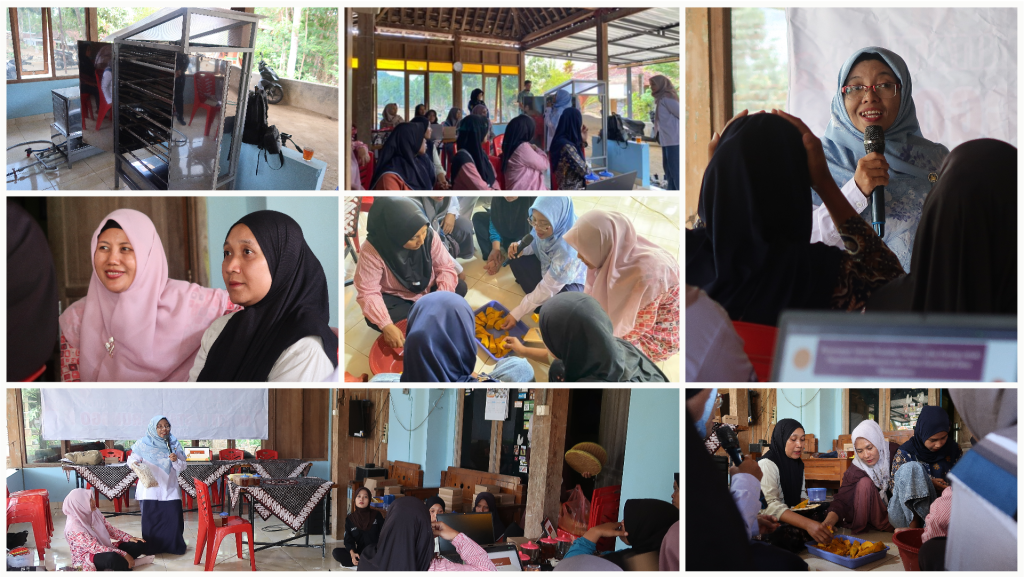
The training and mentoring session was attended by village officials and members of the Farmers’ Women Groups (Kelompok Wanita Tani / KWT) of Selopamioro Village. It opened with a presentation on Selopamioro Village’s potential in pumpkin production and processing, highlighting how drying techniques extend shelf life, generate intermediate products, drive product diversification, and raise market value.
During her presentation, Dr. Devi Yuni Susanti stated:
“Pumpkin is a local food ingredient from Selopamioro Village that has a long shelf life of up to 1 year when unpeeled; diversification of processed pumpkin can be made into flour that can be sold directly or processed further to produce innovative foods such as cake mixes, cookies, and the like.”
Following the presentation, the team provided hands-on guidance on operating and maintaining the cabinet dryer designed and deployed by the team—covering startup and shutdown procedures as well as routine maintenance to sustain machine performance. All participants practiced turning on and operating the dryer firsthand.
Representing KWT Mukti Lestari from Surunggo 2 Hamlet, Rini Marsih, expressed her gratitude for the support:
“On behalf of the mothers of KWT Mukti Lestari from Surunggo 2 Hamlet, I would like to thank Ibu Devi and the team through the appropriate technology implementation program from DBKM UGM for mentoring and training us in postharvest handling and various pumpkin product innovations, as well as providing the production machines and equipment along with how to operate them. Thank you, and may we be able to develop these products further sustainably.”
Alignment with Sustainable Development Goals (SDGs)

Through this appropriate technology transfer, processed pumpkin production in Selopamioro Village is expected to grow in both quantity and quality, broadening market opportunities. The program supports the Sustainable Development Goals (SDGs), particularly SDG 2 (Zero Hunger) by advancing nutritious local food and stunting prevention, and SDG 9 (Industry, Innovation, and Infrastructure) through cabinet dryer technology deployment and rural agro-industrial product innovation.