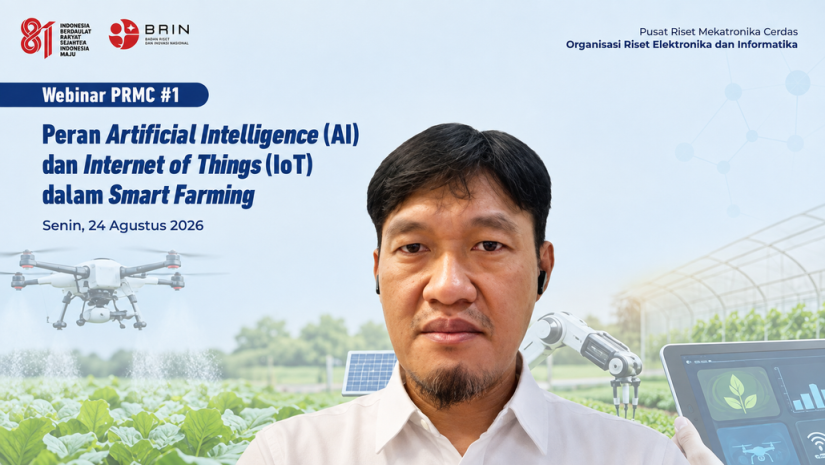
Yogyakarta, August 24, 2026 – The development of Artificial Intelligence (AI) and Internet of Things (IoT) is opening new opportunities for building agricultural systems that are more precise, efficient, and adaptive. These technologies were among the key topics discussed by Ir. Andri Prima Nugroho, S.T.P., M.Sc., Ph.D., IPU., ASEAN Eng., APEC Eng., a researcher at the Smart Agriculture Research Center UGM and a lecturer at the Department of Agricultural and Biosystems Engineering (DTPB), Faculty of Agricultural Technology, Universitas Gadjah Mada (FTP UGM), during the Smart Mechatronics Research Center (PRMC) #1 Webinar organized by the National Research and Innovation Agency (BRIN), Monday (August 24).
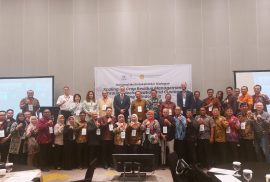
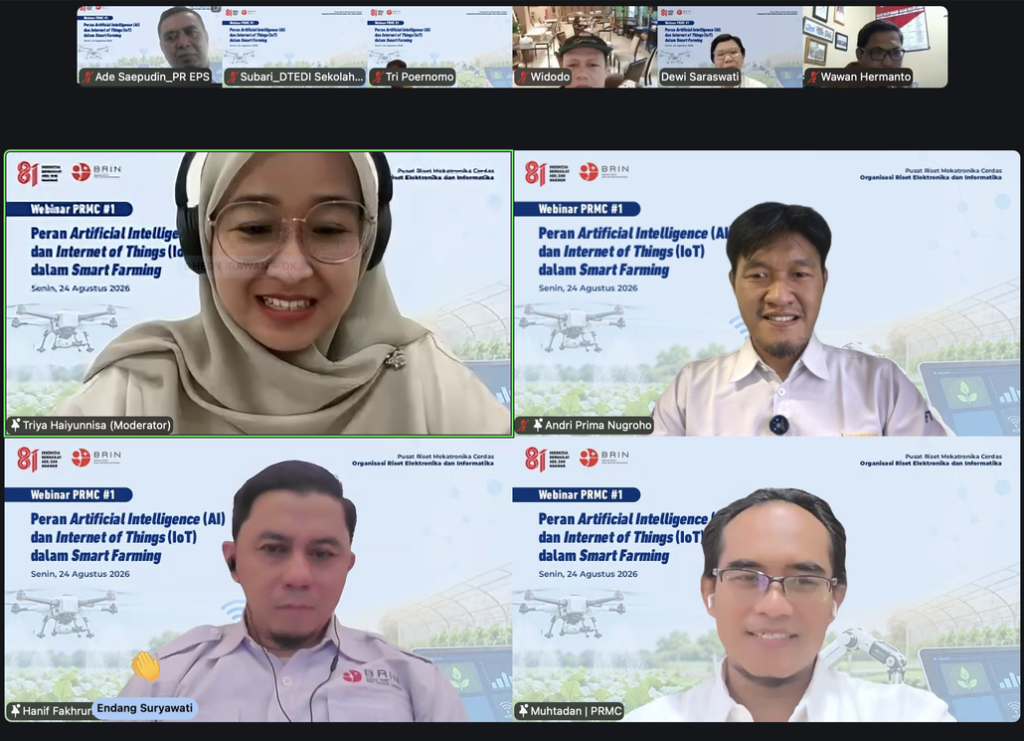
The webinar, themed “The Role of Artificial Intelligence (AI) and Internet of Things (IoT) in Smart Farming,” was organized by the Smart Mechatronics Research Center under BRIN’s Research Organization for Electronics and Informatics. The event was opened by Prof. Yanuandri Putrasari, M.Eng., Ph.D., Head of the Smart Mechatronics Research Center at BRIN, and moderated by Triya Haiyunnisa, M.T., a researcher at the Smart Mechatronics Research Center, BRIN.
Connecting Plant Physiology with Smart Technologies

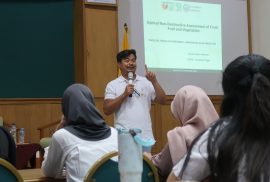
During the webinar, Dr. Andri delivered a presentation entitled “Translating Plant Physiological Insights into Smart Farming Decisions: An AI- and IoT-Enabled Precision Agriculture Approach.”
His presentation explored how information related to plant physiology can be integrated with sensor technologies, IoT, and artificial intelligence to generate relevant information for decision-making in precision agriculture systems.
According to Dr. Andri, developing smart farming systems requires more than simply collecting data using various sensors. An equally important challenge is determining how information about plant and environmental conditions can be analyzed, translated, and utilized to support more accurate agricultural decisions.
This approach positions digital technology not merely as a data-collection tool, but as part of an integrated system capable of transforming data into information and information into a basis for decision-making.
From Sensor Data to Agricultural Decisions
The integration of sensors, IoT, and AI is becoming increasingly important in the development of precision agriculture. Data related to plant and environmental conditions can be used to understand plant responses and determine cultivation practices that are better suited to actual field conditions.

Dr. Andri emphasized that technological development should remain grounded in plant biological needs and real challenges encountered in agricultural production.
Sensor technologies, AI, and IoT provide value when they are capable of generating information that can be used to improve input-use efficiency, understand plant responses, and support more precise cultivation decisions.
This approach is also aligned with various research and development activities conducted by the Smart Agriculture Research Center UGM, particularly in agricultural sensor integration, IoT-based monitoring, plant condition monitoring, sensing technologies, data analysis, and decision support systems.
Bringing Together AI, IoT, and Data Analytics
The PRMC #1 Webinar also featured Prof. Dr. Hanif Fakhrurroja, a researcher at the Smart Mechatronics Research Center, BRIN, who delivered a presentation entitled “Transforming Agricultural Technology through IoT, AI, and Data Analytics.”

Meanwhile, Dr. Muhtadan, a researcher at the Smart Mechatronics Research Center, BRIN, presented “Towards Agentic AI on Edge Devices: From Computer Vision Perception to Autonomous Decision-Making for Industrial Smart Farming.”
Together, the three presentations demonstrated how smart farming development can be approached through interconnected stages. The process begins with understanding plant biological conditions, followed by data collection through sensors and IoT, data processing using AI and data analytics, and the development of intelligent systems capable of supporting faster and more adaptive decision-making.
Strengthening Collaboration between UGM and BRIN
The webinar also served as a platform for knowledge exchange between Universitas Gadjah Mada and BRIN in the development of future agricultural technologies.
Collaboration between universities and national research institutions is important for bringing together agricultural sciences with advances in mechatronics, artificial intelligence, Internet of Things, edge computing, and precision agriculture.
Such synergy is expected to generate technological innovations that are not only technically advanced but also relevant to the needs of Indonesia’s agricultural sector.
For DTPB FTP UGM, the involvement of lecturers and researchers in forums such as this further strengthens the role of academics in promoting the digital transformation of agriculture. Technological development needs to be directed toward addressing real-world challenges while improving the efficiency and sustainability of agricultural production systems.
Promoting Precise and Sustainable Smart Farming
The utilization of AI and IoT in smart farming has significant potential to support more efficient agricultural management through more measurable plant monitoring, data analysis, and information-based decision-making.
Through its involvement in the development and dissemination of smart agricultural technologies, DTPB FTP UGM continues to promote the integration of agricultural science, sensors, IoT, AI, and data analytics to build agricultural systems that are increasingly precise, efficient, adaptive, and sustainable.