Yogyakarta, September 2, 2026 – Developing agricultural technology requires more than scientific knowledge and technological innovation. Connecting science with business is also important to ensure that research and technology can be developed into solutions that provide broader benefits for society.
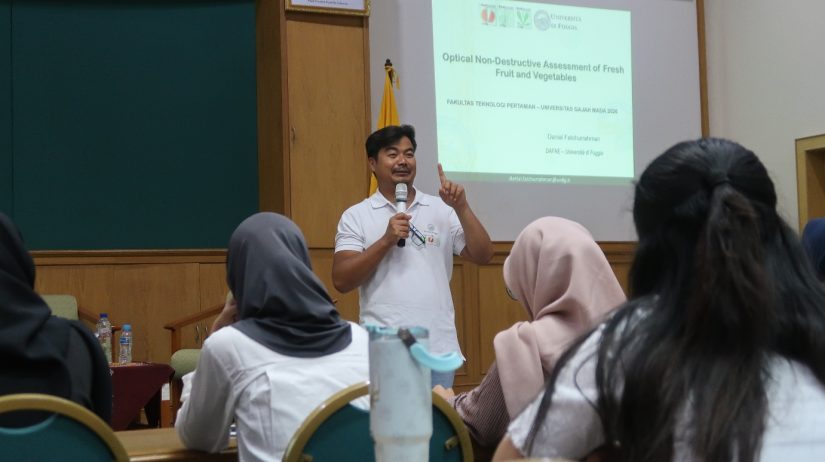
This message was conveyed by Danial Fatcurrahman, Ph.D., a lecturer at the Department of Agricultural Sciences, Food, Natural Resources and Engineering, University of Foggia, Italy, during an international guest lecture entitled “Quality Inspection Techniques for Fresh Products” held by the Department of Agricultural and Biosystems Engineering (DTPB), Faculty of Agricultural Technology (FTP), Universitas Gadjah Mada (UGM), in collaboration with the Computer-aided Postharvest Technology UGM on Wednesday, September 1, 2026.
Held in Room 384 of FTP UGM, the lecture featured Danial Fatcurrahman as the guest speaker, with Bayu Nugraha, Ph.D., serving as moderator. The event was attended by students taking the Postharvest Engineering course.
Combining Science and Business
During the lecture, Danial introduced opportunities for collaboration between UGM and the University of Foggia, particularly in research and development, industry cooperation, and fluorescence engineering.

According to Danial, Italy is one of the major fruit and vegetable producers in Europe. The significant role of horticultural production has encouraged the development of technologies to maintain the quality of fresh products throughout the supply chain.
He also shared his experience conducting research with companies in Europe, particularly on fruit storage. This experience demonstrated the importance of collaboration between higher education institutions and industry in translating scientific research into practical applications.
Danial emphasized that science and business need to be developed together.
“We need to combine science with business, because business allows the results of science and technology to be further developed while also empowering and strengthening our communities.”
He explained that growing public awareness of health and the demand for healthy, safe, and high-quality food products provide opportunities for the development of innovative technologies. Standards and product labeling can also play an important role in strengthening consumer confidence and creating added value.
Non-destructive Technology for Fresh Produce
One of the technologies discussed during the lecture was Near-Infrared (NIR) technology and hyperspectral imaging for product authentication and quality assessment.
These optical technologies enable fresh fruits and vegetables to be assessed rapidly without damaging the products. Such approaches are particularly relevant for maintaining product quality during storage, transportation, and distribution.
Danial explained that the quality of fresh produce can change throughout the supply chain. Therefore, inspection technologies that can provide rapid and accurate information without damaging the products are increasingly important.
The application of non-destructive assessment technology also opens opportunities for more efficient and sustainable postharvest management.
Agricultural Engineering Requires a Multidisciplinary Approach

Danial also highlighted the importance of a multidisciplinary approach in agricultural engineering.
“As agricultural engineering students, we learn about various fields and are required to be multidisciplinary because the problems we will face in our future careers will become increasingly complex, requiring a multidisciplinary approach.”
According to him, agricultural engineering provides students with an opportunity to understand agricultural materials while simultaneously learning about engineering, technology, and systems. This combination can become an important foundation for developing solutions to increasingly complex agricultural challenges.
Understanding Agricultural Materials as an Advantage
The same point was emphasized by Bayu Nugraha, Ph.D., who encouraged students not to give up when pursuing their field of study.
“Do not give up on pursuing our field. Many people from other disciplines can build machines to process agricultural products, but we understand the characteristics and properties of the materials being processed better, enabling us to develop innovations, equipment, or methods that are more appropriate.”
According to Bayu, an understanding of agricultural materials is one of the strengths of agricultural engineering graduates. Such knowledge can help engineers design machines and processing methods that are better suited to the characteristics of the materials being handled.
This understanding becomes increasingly important when technological development needs to respond to specific agricultural and postharvest problems.
Expanding Opportunities for Research and Innovation

The international guest lecture provided students with a broader perspective on the development of fresh produce inspection technologies, particularly through optical and non-destructive assessment approaches.
Beyond technical knowledge, the discussion also highlighted opportunities for agricultural engineering graduates in research, technology development, industry, business, and community empowerment.
Through the combination of knowledge of agricultural materials, technological innovation, multidisciplinary approaches, and an understanding of industry needs, agricultural engineering can contribute to the development of solutions that are not only scientifically relevant but also applicable and economically valuable.
The lecture also strengthened international academic connections between UGM and the University of Foggia while opening opportunities for future collaboration in research, education, and technology development.