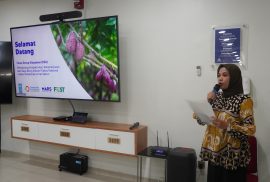
Jember, September 1, 2026 – Strengthening the cocoa downstreaming ecosystem requires synergy among universities, research institutions, government agencies, and industry stakeholders. As part of this effort, a Universitas Gadjah Mada (UGM) team visited the Indonesian Coffee and Cocoa Research Institute (Pusat Penelitian Kopi dan Kakao Indonesia/Puslitkoka) in Jember, East Java, on September 1, 2026. The visit focused on exploring potential collaboration and discussing the revitalization of the role of the Cocoa Teaching and Learning Industry (CTLI) UGM as a UGM facility supporting the practical implementation of cocoa downstreaming.
The visit was attended by Dr. Arifin Dwi Saputro, S.T.P., M.Sc., a lecturer at the Department of Agricultural and Biosystems Engineering (TPB), Faculty of Agricultural Technology (FTP) UGM, together with the UGM Directorate of Business Development and the CTLI UGM team. The meeting provided an opportunity to explore synergies between UGM and Puslitkoka, particularly in technology development, education, research, and cocoa downstreaming.
Discussing the Revitalization of CTLI UGM
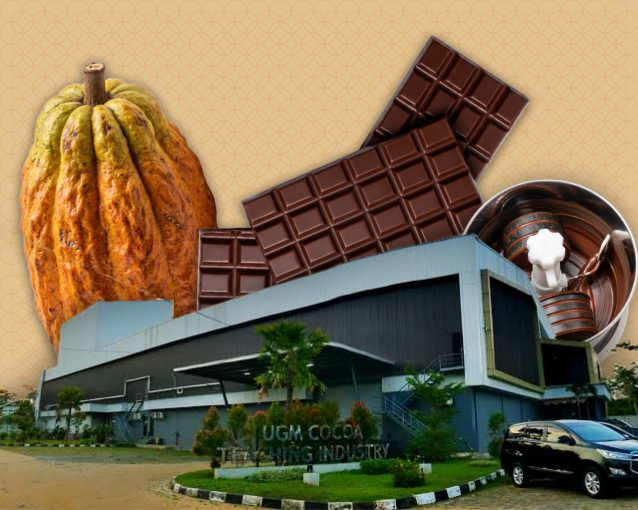
The visit to Puslitkoka focused on exploring potential collaborations to strengthen the role of the Cocoa Teaching and Learning Industry (CTLI) UGM. CTLI is a UGM facility developed to support the practical implementation of cocoa downstreaming, connecting learning, research, technology development, processing, and the development of value-added cocoa products.
The establishment of CTLI is part of UGM’s efforts to provide a space where knowledge and research findings in cocoa can be applied more directly. Through the facility, downstreaming processes can be explored and developed from raw materials to processed products with higher economic value.
Collaboration with Puslitkoka is expected to strengthen this role through the exchange of knowledge, research experience, technology development, and innovation in the cocoa sector. Synergy between UGM’s downstreaming facility and a research institution with extensive experience in cocoa development can also open opportunities for broader collaboration.
TPB UGM Lecturer Expertise in Cocoa

In this context, the involvement of Dr. Arifin Dwi Saputro was an important part of the discussion. His expertise in cocoa and chocolate, particularly in processing technology and product development, represents an important academic asset for UGM in developing collaboration in the cocoa sector.
Dr. Arifin is a lecturer at TPB FTP UGM who completed his doctoral studies (Ph.D.) at Ghent University, Belgium. His academic background and expertise in cocoa and chocolate support UGM’s contribution to the development of processing technologies, product quality improvement, and value-added cocoa products.
Dr. Arifin’s involvement in the discussion with Puslitkoka also demonstrates the recognition of TPB FTP UGM lecturers’ expertise in the field of cocoa and chocolate. This expertise forms part of UGM’s contribution to strengthening cross-institutional collaboration and promoting cocoa development from upstream production to downstream processing.
Indonesia’s Strong Cocoa Potential

Cocoa is one of Indonesia’s strategic plantation commodities, playing an important role in the national economy while offering significant opportunities for downstream development.
According to the Directorate General of Plantations of the Ministry of Agriculture of the Republic of Indonesia, based on plantation statistics, Indonesia’s cocoa production in 2024 reached approximately 617,000 tons, with a cultivated area of around 1.37 million hectares. Cocoa production in 2025 was estimated at approximately 616,000 tons, while production in 2026 is projected to increase to around 635,000 tons, with a cultivated area of approximately 1.38 million hectares.
These figures demonstrate Indonesia’s strong raw-material base for developing the domestic cocoa processing industry. Improving productivity and raw-material quality is increasingly important to ensure that cocoa can generate greater economic value for farmers and the national industry.
In terms of international trade, Indonesian cocoa also holds an important position in the global market. According to the Directorate General of Plantations of the Ministry of Agriculture, data from Statistics Indonesia (BPS) processed by the Directorate General of Plantations recorded Indonesia’s cocoa exports in 2024 at approximately 348,000 tons, with an export value of US$2.65 billion.
Meanwhile, the Ministry of Agriculture’s 2025 Cocoa Trade Performance Analysis stated that cocoa was one of the important commodities in Indonesia’s plantation trade. In 2024, cocoa exports contributed approximately US$2.65 billion in foreign exchange earnings, representing 7.62 percent of the total export value of plantation commodities.
These figures highlight the importance of cocoa as both a plantation commodity and a major economic opportunity. However, strengthening Indonesia’s cocoa industry cannot rely solely on increasing production. Improving raw-material quality, strengthening postharvest and processing technologies, and developing downstream products are also essential to increasing the competitiveness of the national cocoa industry.
Downstreaming Creates Opportunities for Added Value
Downstreaming is an important opportunity for strengthening Indonesia’s cocoa industry. Cocoa commodities do not have to stop at the production of cocoa beans but can be developed into a range of intermediate and final products with higher added value.
According to the Directorate General of Plantations of the Ministry of Agriculture, the government is encouraging the strengthening of cocoa processing industries, ranging from fermented cocoa beans, cocoa liquor, and cocoa butter to finished chocolate products. Developing these processing chains is expected to increase the value captured domestically.
Cocoa beans can also be processed into intermediate products such as cocoa nibs, cocoa mass, cocoa liquor, cocoa butter, and cocoa powder, before being further developed into a variety of chocolate and processed food products.
Developing this value chain provides Indonesia with an opportunity to obtain greater economic value from its cocoa commodities. Downstreaming can also stimulate the growth of processing industries, create employment opportunities, strengthen human resources, and enhance connections among farmers, research institutions, universities, and industry.
Beyond conventional processed products, Indonesia also has opportunities to develop cocoa products with distinctive characteristics and premium quality. Strengthening bean quality, fermentation processes, processing technologies, product innovation, and marketing strategies will be important for improving the competitiveness of Indonesian cocoa in the global market.
Building a Cocoa Ecosystem from Research to Industry

The UGM visit to Puslitkoka is part of an effort to develop a collaborative ecosystem connecting research, education, technology, and industry.
The revitalization of CTLI UGM is expected to further strengthen its role as a UGM facility for the practical implementation of cocoa downstreaming. The facility can support not only learning and training but also processing technology development, product testing and development, and the application of research outcomes into value-added cocoa products.
Synergy between CTLI UGM and Puslitkoka also creates opportunities to strengthen knowledge and technology transfer to students, business actors, and communities. With the expertise of UGM lecturers and the research facilities available at the respective institutions, collaboration can be directed toward developing more applicable cocoa innovations that respond to industrial and market needs.
The involvement of Dr. Arifin Dwi Saputro further strengthens the role of TPB FTP UGM in developing technology based on agricultural commodities. His expertise in cocoa and chocolate represents a strategic contribution to developing value-added products while strengthening practical cocoa downstreaming through CTLI UGM.
Through collaboration between UGM and Puslitkoka, cocoa development is expected to focus not only on increasing production but also on improving quality, fostering product innovation, strengthening human resources, and creating added value throughout the cocoa value chain, from upstream to downstream.