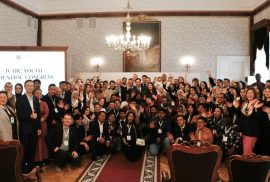
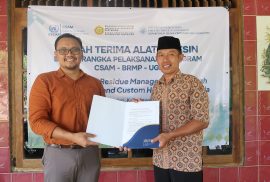
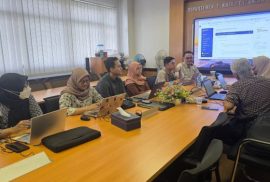
Yogyakarta, April 21, 2026 — The Faculty of Agricultural Technology, Universitas Gadjah Mada (FTP UGM), through the Center for Irrigation and Agricultural Modernization Studies (PKMIP), organized a policy formulation workshop on single irrigation management at the FTP UGM Operation Room. The event brought together academics, government representatives, and practitioners to develop a more integrated and implementable irrigation management concept.
This workshop is part of broader efforts to strengthen the national irrigation system, which plays a strategic role in supporting food security, particularly amid challenges such as climate change, population growth, and increasing pressure on water resources.
Cross-Sector Collaboration in Policy Formulation

The event was attended by various stakeholders, both onsite and online. From the internal side, the Head of the Department of Agricultural and Biosystems Engineering FTP UGM, Dr. Arifin Dwi Saputro, represented the Dean of FTP UGM. Also उपस्थित were the Chairman of the Indonesian Irrigation Operation and Maintenance Personnel Association (P2OPI), Ir. Djito, S.P., and the Acting Director of Water Resources at the Ministry of National Development Planning (Bappenas), Ir. Juari, M.E.
From academia, participants included the Head of PKMIP FTP UGM, Dr. Ansita Gupitakingkin Pradipta; PKMIP Expert Board member and Professor in irrigation engineering and management, Prof. Sigit Supadmo Arif; as well as PKMIP lecturers and researchers such as Ir. Andri Prima Nugroho, Ph.D.; Hanggar Ganara Mawandha, Ph.D.; Dr. Ngadisih; and Chandra Setyawan, Ph.D.
The workshop also involved key stakeholders attending online, including Dr. L.M. Bakti, S.T., M.T., Head of the Groundwater and Raw Water Subdirectorate, Directorate of Irrigation and Swamps, Directorate General of Water Resources, Ministry of Public Works; Dr. Dede Sulaeman, Director of Land Protection and Optimization, Directorate General of Land and Irrigation, Ministry of Agriculture; as well as representatives from the Irrigation Engineering Center and the Swamp Engineering Center under the Directorate General of Water Resources, Ministry of Public Works. Additionally, representatives from the Coordinating Ministry for Food (Deputy for Food and Agricultural Business Coordination) and the Directorate of Agricultural Land and Irrigation Mapping, Ministry of Agriculture, were also present.
The event also involved undergraduate, master’s, and doctoral students of Agricultural Engineering UGM, including one doctoral student, as part of the academic learning process.
Urgency of Regulation and Irrigation Integration

During the discussion, participants emphasized the urgency of accelerating derivative regulations from Law No. 17 of 2019 on Water Resources, particularly the Draft Government Regulation on Irrigation. To date, the regulation has not yet been issued despite a considerable transition period.
The concept of single irrigation management emphasizes integrated management from primary to tertiary irrigation networks. Although implementation authority lies across multiple ministries, technical planning is expected to remain within a unified framework to ensure efficiency and sustainability.
Irrigation Modernization and Human Resource Development

The workshop also highlighted the need to redefine irrigation modernization beyond infrastructure, incorporating management, institutional, and human resource aspects.
Digitalization of operation and maintenance (O&M) reporting systems was identified as a key priority, transitioning from manual systems to more efficient and responsive digital platforms. Strengthening the capacity of O&M personnel through training and certification was also considered crucial to improving irrigation service quality.
Strategic Role of an Academic Institution

As an academic institution, FTP UGM through PKMIP plays a neutral, science-based role in bridging policy needs and field practices. The workshop is expected to produce policy recommendations that can contribute to the formulation of Government Regulations on Irrigation.
Student involvement in this activity also reflects the implementation of the university’s tridharma, particularly in education and community engagement.
Contribution to the SDGs
This workshop directly contributes to several Sustainable Development Goals (SDGs), including:
- SDG 2 (Zero Hunger): strengthening irrigation systems to improve agricultural productivity and national food security
- SDG 6 (Clean Water and Sanitation): promoting efficient, integrated, and sustainable water resource management
- SDG 9 (Industry, Innovation and Infrastructure): advancing innovation and modernization of irrigation systems
- SDG 17 (Partnerships for the Goals): fostering cross-sector collaboration among government, academia, and practitioners
This approach demonstrates that irrigation modernization extends beyond agriculture, forming part of a broader sustainable development agenda. Through this workshop, it is expected that cross-sector synergy will be strengthened in formulating more integrated, adaptive, and sustainable irrigation policies, ultimately supporting a resilient national agricultural system and safeguarding Indonesia’s food security in the future.