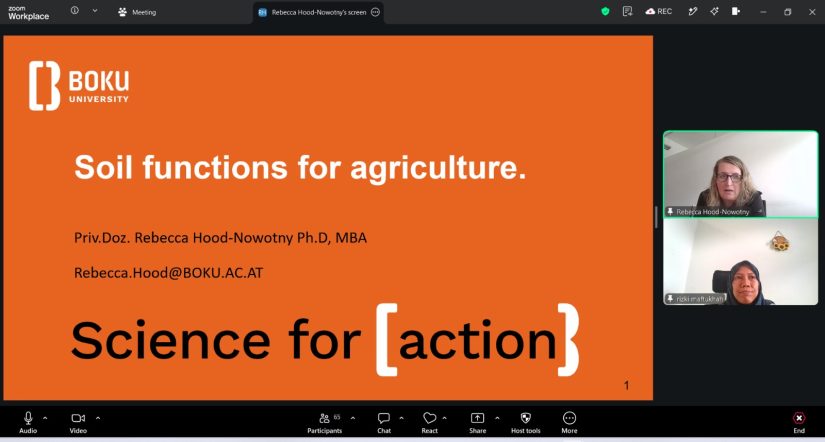
Yogyakarta, August 19, 2026 – Soil is not merely a medium for plant growth but a complex system that plays essential roles in food production, water regulation, carbon storage, nutrient cycling, and biodiversity conservation. This perspective was highlighted during the International Guest Lecture “Soil Function for Agriculture”, organized by the Department of Agricultural and Biosystems Engineering (DTPB), Faculty of Agricultural Technology, Universitas Gadjah Mada (FTP UGM), on Wednesday (August 19).
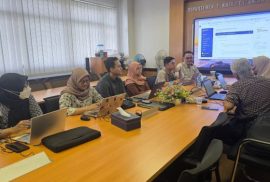
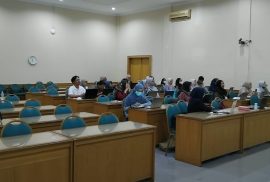
The lecture featured Priv.-Doz. Rebecca Hood-Nowotny, M.B.A., Ph.D., from the Institute for Soil Research, Department of Ecosystem Management, Climate and Biodiversity, BOKU University, Austria, as the guest speaker. The session was moderated by Dr.nat.techn. Rizki Maftukhah, S.T.P., M.Sc., a lecturer at DTPB FTP UGM, and was attended by students from DTPB FTP UGM.
Through the lecture, participants were invited to view soil from a broader perspective—not only as a growing medium for crops, but also as an ecosystem that performs a wide range of functions essential to sustainable agriculture.
Understanding the Multiple Functions of Soil in Agriculture

At the beginning of her presentation, Rebecca invited participants to reconsider the fundamental role of soil within ecosystems. She explained that soil performs several key functions closely connected to human life and agricultural sustainability.
Soil functions as a medium for plant growth and the production of food, fiber, and fuel. It also plays an important role in climate regulation and carbon sequestration, nutrient supply, water regulation and purification, and providing habitat for soil biodiversity.
“The main soil functions are that soils are medium for plant growth, food, fibre, and fuel; climate regulation and carbon sequestration; nutrient delivery; water regulation and purification; and also the soil is a vast habitat for biodiversity,” Rebecca explained.
Rebecca also emphasized that soil is a highly complex environment resulting from interactions among its physical, chemical, and biological components. Soil structure and texture interact with fungi, bacteria, macrofauna, viruses, and plant roots to support various processes taking place within the soil.
Soil as the Foundation of Food Production
One of the key functions discussed during the lecture was the role of soil as a medium for plant growth. Rebecca explained that a significant proportion of global food production is directly or indirectly dependent on soil.
In her presentation, she noted that approximately 95 percent of global food production is associated with soil, while the remainder comes from production systems such as aquaculture and fisheries. She also explained that approximately 20 percent of the world’s agricultural land is irrigated, yet these areas contribute around 40 percent of global crop production.
Soil also serves as an anchor for plant growth while supplying water and nutrients. Rebecca explained that most plant roots are concentrated in the upper soil layer, where organic matter and nutrient availability are generally higher.
This highlights the importance of managing topsoil effectively to maintain agricultural productivity while preserving the ecological functions of soil.
Organic Matter Supports Water and Nutrient Availability

The discussion then focused on the importance of organic matter in maintaining soil functions. Rebecca explained that organic matter acts somewhat like a sponge, enabling soil to retain water during rainfall.
In addition to water retention, increased organic matter is associated with greater nutrient availability through the process of mineralization. Therefore, maintaining organic matter is closely related to the soil’s ability to support plant growth and agricultural productivity.
Rebecca also emphasized the importance of infiltration and percolation. Healthy soil with adequate porosity can absorb rainfall, reducing surface runoff and the risk of erosion. Stable soil aggregates are one of the factors supporting this capacity.
Soil as a Carbon Reservoir
Another important topic discussed during the lecture was the ability of soil to store carbon. Rebecca explained that soil is one of the largest near-surface terrestrial carbon reservoirs.
In the context of climate change, soil carbon storage is increasingly important because soil carbon dynamics are influenced by the balance between biomass production and decomposition processes. Rising temperatures can also accelerate decomposition, potentially increasing carbon emissions from soil into the atmosphere.
According to Rebecca, agricultural land also has considerable potential to increase carbon sequestration through appropriate soil management practices. Climate change mitigation, therefore, is not limited to forest ecosystems but can also be pursued through sustainable agricultural soil management.
Managing Soil through Carbon Management
Toward the end of her presentation, Rebecca emphasized that improving soil functions is closely linked to increasing soil carbon.
Several management strategies can be implemented, including minimizing soil disturbance through no-till or low-till practices, maintaining living roots for as long as possible, keeping soil surfaces covered with mulch, appropriately integrating livestock, and increasing crop diversity.
She also explained that carbon inputs from belowground biomass, particularly plant roots, play an important role in soil carbon management. Therefore, agricultural management strategies need to pay greater attention to root systems and maintaining living plants within agricultural landscapes.
This approach demonstrates that sustainable soil management should not focus solely on productivity within a single growing season, but also on maintaining the soil’s ecological functions over the long term.
Soil Biodiversity Supports Ecosystem Health
In addition to carbon and water, soil biodiversity was another important component of the lecture. Rebecca explained that soil is a habitat for highly diverse microbial communities.
A single teaspoon of soil can contain millions of microorganisms that contribute to various ecological processes. This diversity creates a highly complex environment and supports multiple soil functions.
Rebecca also discussed the relationship between microbial diversity and the ability of soil to suppress pathogens. Active and diverse microbial communities can increase competition against harmful organisms and contribute to soil health.
She compared the soil microbial community to the microbiome of the human body, in which a healthy microbial community can improve resilience against harmful organisms.
This perspective reinforces the understanding that protecting soil also means protecting the microscopic life that exists within it.
Expanding Students’ Perspectives on Sustainable Agriculture

The International Guest Lecture “Soil Function for Agriculture” provided students with an opportunity to gain an international perspective on soil science and its application in modern agricultural systems.
Through Rebecca’s presentation, students were encouraged to understand that agricultural productivity cannot be separated from the ability of soil to perform its various ecological functions. Food production, nutrient cycling, water regulation, carbon storage, and biodiversity are interconnected functions that collectively contribute to a sustainable agricultural system.
The discussion session also provided opportunities for students to raise questions concerning soil health, microorganisms, and soil management practices. One discussion explored how beneficial soil microorganisms can be maintained when dealing with soil pathogens. Rebecca explained that increasing organic carbon and microbial diversity can form part of an approach to maintaining soil health.
Strengthening the Internationalization of Education at DTPB FTP UGM
The International Guest Lecture was part of DTPB FTP UGM’s efforts to broaden students’ academic perspectives through direct interaction with international experts.
The participation of an academic from BOKU University, Austria, also strengthened international academic networks in the fields of soil science and sustainable agriculture. This exchange of knowledge is expected to provide new perspectives for students and academic staff in developing research and innovations that address agricultural and environmental challenges.
Through this activity, DTPB FTP UGM continues to promote an educational and research approach that recognizes soil as a fundamental foundation for food production, ecosystem resilience, and sustainable agriculture.
Ultimately, understanding soil functions is important not only for improving agricultural productivity, but also for ensuring that soil resources remain capable of performing their ecological functions for future generations.