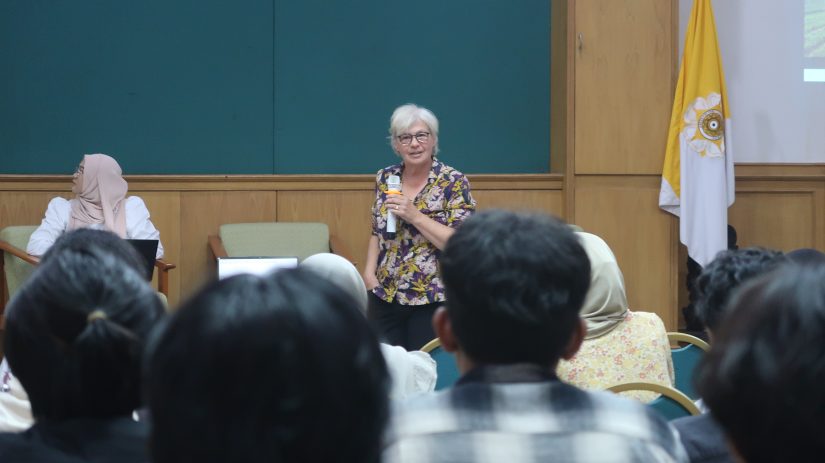
Yogyakarta, August 18, 2026 – Climate change and increasing uncertainty in water resources require irrigation systems to move beyond simply providing water for crops and to also consider environmental and ecosystem sustainability. This perspective was highlighted by Prof. Charlotte de Fraiture, Professor of Land and Water Development and Vice Rector Academic & Student Affairs at the IHE Delft Institute for Water Education, during the International Guest Lecture entitled “Irrigation in The Era of Uncertainties,” organized by the Department of Agricultural and Biosystems Engineering (DTPB), Faculty of Agricultural Technology, Universitas Gadjah Mada (FTP UGM), on Tuesday (18/8).
The event was held both onsite in Classroom 384, FTP UGM, and online via video conference. It was attended by undergraduate, master’s, and doctoral students within DTPB FTP UGM and moderated by Dr. Eng. Ansita Gupitakingkin Pradipta, S.T., M.Eng., IPM., a lecturer at DTPB FTP UGM.
Strengthening Academic Networks in Irrigation
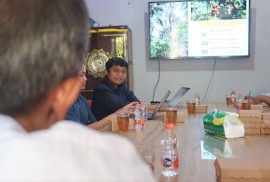
Before delivering the guest lecture, Prof. Charlotte de Fraiture met with the DTPB FTP UGM leadership and researchers. During her visit, Prof. Charlotte was accompanied by Ahmad Rif’an Khoirul Lisan, S.Si., M.S., a lecturer in Soil Science at UPN “Veteran” Yogyakarta.
Prof. Charlotte was welcomed by Dr. Arifin Dwi Saputro, S.T.P., M.Sc., Head of the Department of Agricultural and Biosystems Engineering; Dr. Chandra Setyawan, S.T.P., M.Eng., Ph.D., Department Secretary; Dr. Eng. Ansita Gupitakingkin Pradipta, S.T., M.Eng., IPM., Head of the Center for Agricultural Irrigation Modernization Studies; and Prof. Dr. Ir. Sigit Supadmo Arif, M.Eng., Ph.D., Professor of Irrigation Engineering and Management.
The meeting provided an opportunity to introduce DTPB FTP UGM’s research and development activities in irrigation modernization while discussing potential collaboration with the IHE Delft Institute for Water Education.
Introducing Research and Innovation in Irrigation Modernization

During the meeting, Dr. Ansita Gupitakingkin Pradipta and Prof. Sigit Supadmo Arif introduced several projects and activities developed by DTPB FTP UGM in the field of irrigation modernization.
One of the innovations introduced was SIPASI, a Decision Support System developed to support irrigation management and decision-making processes. SIPASI has been adopted in several irrigation areas across Indonesia.
The introduction of SIPASI was part of a broader discussion on the implementation of research outcomes and technological innovations developed by DTPB FTP UGM to support irrigation management in the field. The development of this decision support system also reflects efforts to establish irrigation systems that are more responsive to changing water-resource conditions.
The meeting continued with discussions on potential collaboration between DTPB FTP UGM and IHE Delft, particularly in research, irrigation system development, water resource management, and technological approaches to addressing uncertainty.
Rethinking the Role of Irrigation Amid Uncertainty

During her guest lecture, Prof. Charlotte discussed various challenges facing irrigation systems in an increasingly uncertain environment. One of the adaptation approaches she highlighted was the need to reconsider the broader meaning and benefits of irrigation.
According to Prof. Charlotte, irrigation systems should not be viewed solely in terms of their ability to provide water for food crops. Water management systems should also consider their broader functions in supporting environmental and ecosystem sustainability.
“Another adaptation to uncertainty is to broaden our perception of the meaning of irrigation, so that its benefits go beyond simply providing water for food crops, but also contribute to the sustainability of nature and ecosystems.”
This perspective places water infrastructure and management systems, such as dams and reservoirs, within a broader context. In addition to supporting agricultural needs, water management can help prevent flooding in residential areas, support groundwater recharge, and maintain biodiversity.
Therefore, the development of irrigation systems needs to consider the various functions of water resources in an integrated manner. Such an approach is increasingly important in responding to environmental conditions that are becoming more dynamic and uncertain.
Providing New Perspectives for Students

Prof. Charlotte’s participation in the DTPB FTP UGM academic forum provided undergraduate, master’s, and doctoral students with an opportunity to gain an international perspective on developments in irrigation systems and water resource management.
Students were able to engage with discussions on water management challenges while exploring how irrigation approaches can be developed to address the needs of agriculture, the environment, and society more broadly.
The forum also served as a platform for knowledge exchange between an international academic and the DTPB FTP UGM academic community, while introducing the department’s research and innovation in irrigation modernization.
Encouraging International Collaboration

The International Guest Lecture “Irrigation in The Era of Uncertainties” was part of DTPB FTP UGM’s efforts to expand its international academic network while strengthening research in land and water resources engineering to address global challenges.
The meeting with Prof. Charlotte also opened opportunities for further collaboration between DTPB FTP UGM and the IHE Delft Institute for Water Education. Such collaboration may develop through joint research, knowledge exchange, academic capacity building, and other international programs.
Through this activity, DTPB FTP UGM continues to promote an irrigation paradigm that is not solely oriented toward agricultural productivity, but also supports ecosystem sustainability, community resilience to environmental change, and more adaptive water resource management in an era of uncertainty.