Vienna, Austria, May 2026 – As the global demand for electric vehicles (EVs), renewable energy technologies, and electronic devices continues to grow, the demand for tin is also increasing. According to Trading Economics, Indonesia, the world’s second-largest tin producer, produced approximately 50,000 tons of refined tin in 2024 and recorded annual export revenues of around US$1.43 billion. This significant contribution highlights the strategic role of tin in supporting national industries and global supply chains. However, alongside its economic benefits, tin mining activities leave behind substantial environmental challenges, particularly the need for sustainable rehabilitation of post-mining lands.
Addressing this issue, researchers from the Department of Agricultural and Biosystems Engineering (DABE), Faculty of Agricultural Technology, Universitas Gadjah Mada (UGM), introduced innovative concepts for post-tin mining land rehabilitation based on soil health and food safety at the prestigious EGU General Assembly 2026.
EGU 2026 Jadi Panggung Ilmiah Global
EGU 2026: A Global Scientific Stage
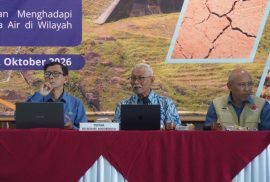
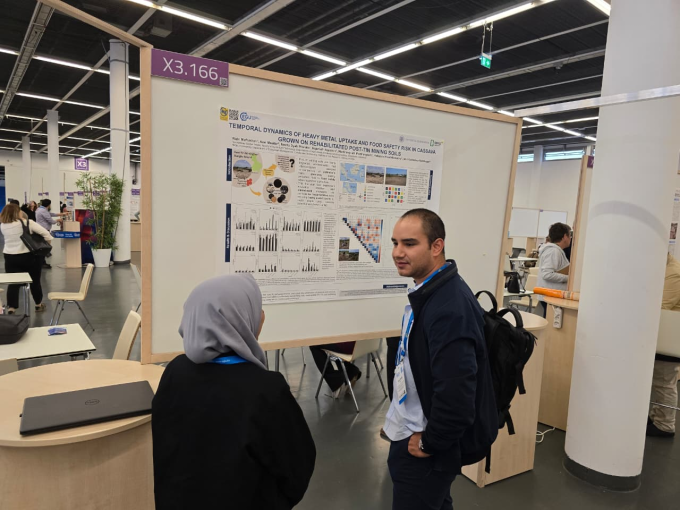
The research was presented at the EGU General Assembly 2026, held from May 3–8, 2026, in Vienna, Austria. Organized by the European Geosciences Union (EGU), the conference is one of the world’s leading scientific forums in earth sciences, environmental sciences, and planetary systems, bringing together approximately 19,000 scientists from around the globe.
The event serves as an important platform for researchers to expand networks, establish international collaborations, showcase innovations, and discuss scientific solutions to strategic global challenges.
Participation in a conference of this scale also contributes significantly to research development by facilitating knowledge exchange, access to emerging technologies, and interdisciplinary collaboration opportunities
UGM Promotes Soil Health and Food Safety-Based Solutions
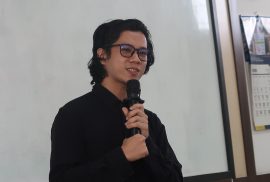
A delegation from DABE UGM, consisting of faculty members and graduate students, presented two studies related to post-tin mining land rehabilitation using bio-based approaches.
The first poster was presented by Novita Dyah Pitaloka, a Master’s student in Agricultural Engineering at UGM, entitled:
“Evaluating Post-Tin Mining Soil Regeneration and Heavy Metal Immobilization in Spinach (Amaranthus sp.) Using Biochar and Compost as Soil Amendments.”
The study evaluated the effectiveness of biochar and compost as soil amendments to support soil regeneration while reducing heavy metal mobility in post-mining soils.
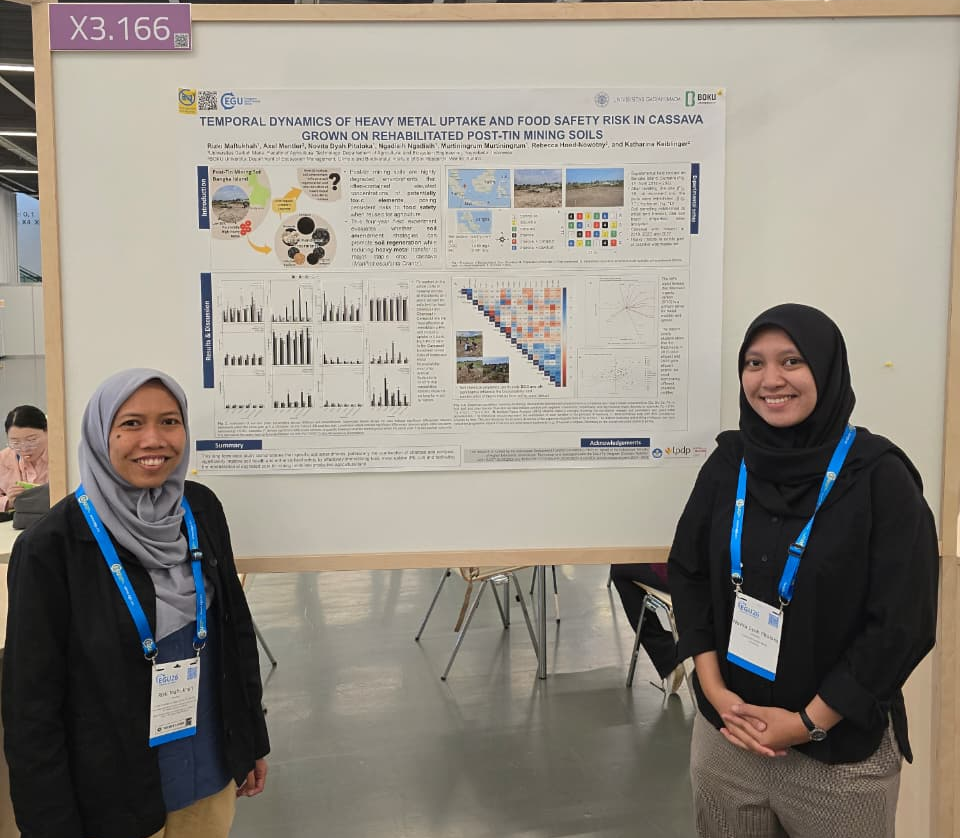
Meanwhile, Dr. nat. techn. Rizki Maftukhah presented a study entitled:
“Temporal Dynamics of Heavy Metal Uptake and Food Safety Risk in Cassava Grown on Rehabilitated Post-Tin Mining Soils.”
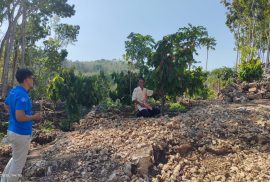
This research investigated heavy metal uptake dynamics in cassava cultivated on rehabilitated post-mining land and assessed potential food safety risks associated with agricultural production in such environments.
Both studies emphasized that successful land rehabilitation should not only be measured by vegetation growth but also by improvements in soil health, agricultural product quality, and food safety for consumers.
Dorong Gagasan Sustainable Agriculture
According to Dr. Rizki Maftukhah, participation in EGU General Assembly 2026 provided an opportunity not only to disseminate research findings but also to broaden scientific perspectives and establish international collaborations.
“Forums such as EGU provide opportunities to share our research on a global stage while receiving valuable feedback from fellow researchers. We can exchange ideas, expand our networks, and gain insights into the latest technological developments and research instruments, particularly in the fields of soil health and food safety,” she explained.
She further noted that such experiences can stimulate future research initiatives addressing sustainable agriculture and environmental challenges.
“We hope that participation in international forums like this will inspire future research, particularly studies related to sustainable agriculture and practical solutions to environmental challenges,” she added.
DABE UGM’s Commitment to Addressing Global Environmental Challenges
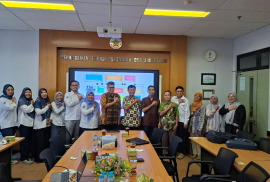
The participation of DABE UGM faculty members and students in EGU General Assembly 2026 was supported through the World Class Academic Excellence Equity Program 2025/2026 Scheme B and collaborative partnerships with BOKU Vienna and BRIN.
This involvement demonstrates DABE UGM’s commitment to producing research that is not only academically excellent but also capable of addressing real-world challenges.
Through the development of soil health- and food safety-based post-mining rehabilitation strategies, UGM researchers hope to contribute sustainable solutions for tin-producing regions such as Bangka while supporting global agendas on food systems and environmental management for the future.