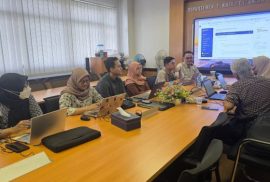
SINGAPORE – The opportunity to participate in a benchmarking visit to the Singapore Institute of Technology (SIT) on June 11, 2026, was an invaluable experience for me as a researcher at the Smart Agriculture Research Center (SARC), Universitas Gadjah Mada (UGM). This visit was part of UGM’s strategic initiative to develop an artificial intelligence (AI) ecosystem capable of addressing real-world industrial and societal challenges.
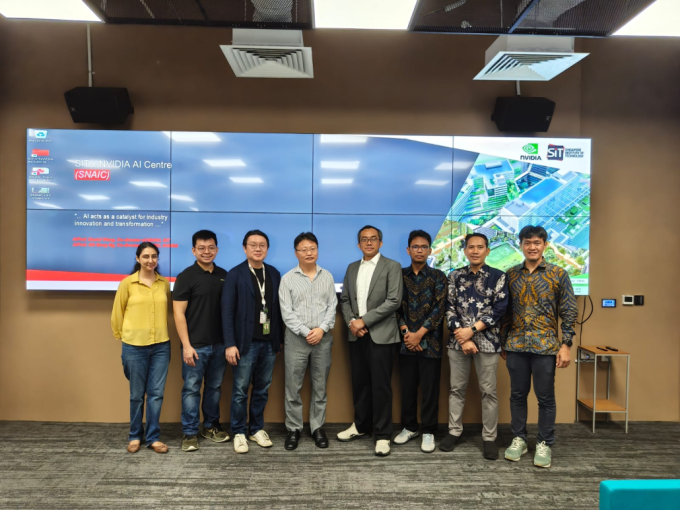
The UGM delegation consisted of dr. Dian Kesumapramudya Nurputra, Sp.A., Ph.D., Dr. Nur Mohammad Farda, S.Si., M.Cs., Ir. Andri Prima Nugroho, S.T.P., M.Sc., Ph.D., and Muhammad Alif Taufiqurrahman, S.Kom., M.Kom. The team represented diverse fields of expertise, ranging from healthcare, remote sensing, and smart agriculture to information systems and digital transformation.
This visit forms part of UGM’s broader effort to establish an AI ecosystem that not only serves as a hub for cutting-edge research but also accelerates innovation commercialization and digital transformation across strategic sectors. Through ongoing collaborations with NVIDIA and industry partners, UGM is currently developing the concept of an AI center that bridges academia, industry, and society.
During the visit, the UGM team had the opportunity to explore the SIT x NVIDIA AI Centre (SNAIC), a leading AI center established through a collaboration between the Singapore Institute of Technology and NVIDIA. The delegation was warmly welcomed by Associate Professor Daniel Wang Zhengkui, Co-Director of SNAIC, along with Associate Professor Aik Beng Ng, Dr. Timothy Liu, and several researchers and research engineers involved in strategic AI projects in Singapore.

AI Driven by Industry Needs
One of the most valuable lessons I learned from SNAIC was how all research activities are rooted in industry needs. Unlike conventional academic approaches that often begin with scientific curiosity alone, SNAIC develops research based on real-world challenges faced by industry and society.
Their collaboration model is highly systematic. It begins with identifying partners’ needs through a pre-engagement questionnaire, followed by technical consultations, solution design, technology development, and capacity-building programs.
This approach provides important inspiration for the development of Smart Agriculture Research Center UGM. As a research center focused on agricultural digital transformation, SARC must not only produce high-quality scientific publications but also deliver services and solutions that create tangible impacts for farmers, the agri-food industry, governments, and society at large.
Agriculture as a Flagship AI Sector at UGM
Through discussions with SNAIC researchers, I see tremendous opportunities for agriculture to become one of the flagship applications of AI in Indonesia.
Indonesia faces complex challenges in the agricultural sector, including land productivity, water and fertilizer use efficiency, climate change mitigation, and farmer regeneration. These challenges require data-driven and intelligent technologies capable of supporting fast and accurate decision-making.
As a researcher in Agricultural Informatics, I believe AI can play a transformative role in many aspects of modern agriculture, including:
- Crop monitoring systems based on sensors and the Internet of Things (IoT);
- Drone and satellite image analysis for crop growth monitoring;
- Yield prediction and crop failure risk assessment;
- Precision water and nutrient management;
- Development of agricultural digital twins;
- AI-based decision support systems for farmers and extension workers;
- Integration of Large Language Models (LLMs) as intelligent assistants in agriculture.
During the discussions, we also introduced several initiatives currently being developed at UGM, particularly through SARC, to integrate AI technologies with the needs of Indonesia’s agricultural sector.

Learning from a World-Class AI Research Center
Beyond witnessing demonstrations of cutting-edge technologies such as AI Debater, Automated Visual Acuity Testing (AutoVA), and VISio, a platform capable of converting flowcharts into AI workflows automatically, I was particularly interested in SNAIC’s research governance model.
SNAIC is built upon three major pillars:
- Industry Enablement;
- Applied Research and Development;
- Talent Development.
This framework enables the research center to function not only as a research institution but also as a bridge connecting academia, industry, government, and society.
For Smart Agriculture Research Center UGM, this model highlights the importance of defining a clear niche expertise, developing a portfolio of professional services, and establishing a sustainable business model that extends beyond research grants to include consulting services, system development, training, and industrial partnerships.
Furthermore, SNAIC’s professional website and branding demonstrate how a research center can build international credibility and visibility through effective communication with the public and prospective partners.
Exploring International Collaboration Opportunities
The discussions continued in a more relaxed atmosphere over lunch in Punggol, Singapore. During this session, potential collaborations between UGM and SIT were explored in greater depth, including joint publications, international research proposals, student and staff exchange programs, and opportunities for graduate studies for UGM students.
For me, international collaborations like this are essential to accelerating AI research capacity in Indonesia. Challenges in agriculture, food systems, healthcare, and environmental sustainability are increasingly global and require interdisciplinary and cross-country cooperation.
Towards an AI Ecosystem for Indonesian Agriculture
The visit to SNAIC provided a clear illustration of how an AI center can serve as a catalyst for national innovation through close collaboration among universities, industries, and governments.
As part of Smart Agriculture Research Center UGM, I see this experience as a valuable reference for developing an AI center dedicated to transforming Indonesian agriculture. Supported by a strong ecosystem, international collaboration, and a focus on solving real-world problems, AI has the potential to become a major driving force for creating agricultural systems that are more productive, sustainable, and resilient to future challenges.
Through the lessons learned from SNAIC, we are increasingly optimistic that Indonesia has the potential to become one of Southeast Asia’s leading AI innovation hubs, particularly in developing intelligent technologies for agriculture and food systems.
For me personally, this visit not only broadened my understanding of the latest AI technologies but also demonstrated how an AI center can be sustainably developed through synergy among universities, industry, and government. The experience gained from SNAIC will serve as an invaluable reference in the development of the NVIDIA AI Technology Center (NVAITC) at UGM. With UGM’s multidisciplinary strengths in agriculture, healthcare, environment, and digital transformation, we are optimistic that the AI center currently being initiated will become a catalyst for impactful innovations that benefit Indonesia.