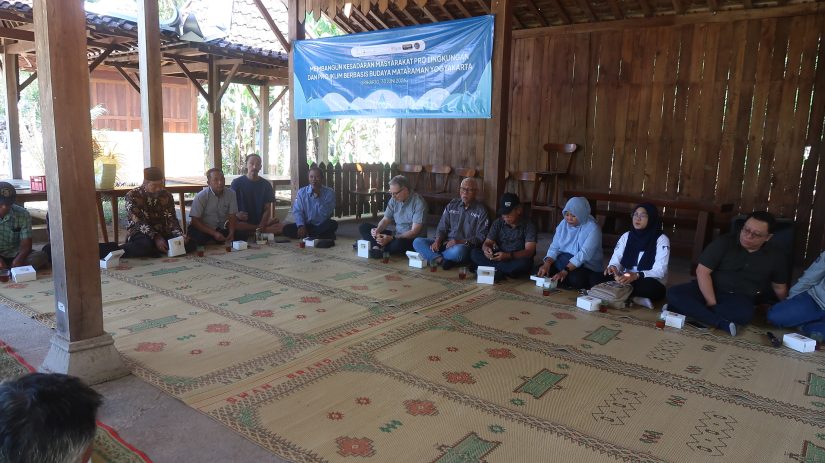
Bantul, June 30, 2026 – Strengthening community resilience to climate change requires more than technological innovation; it also depends on fostering environmental awareness rooted in local culture. With this vision, the Department of Agricultural and Biosystems Engineering (DTPB), Faculty of Agricultural Technology, Universitas Gadjah Mada (FTP UGM), together with the Center for Irrigation Modernization and Agriculture Studies (PK-MIP) and the Land and Water Resources Engineering Laboratory (TSLA), officially launched the Pro-Environment and Pro-Climate Village initiative in Sriharjo Village, Bantul Regency. The program serves as a collaborative platform that brings together academics, local government, and the community to develop sustainable environmental management based on the Mataraman cultural heritage.
The launching ceremony was held on June 30, 2026, at Pendhapa Srikeminut, Sriharjo, one of DTPB FTP UGM’s long-standing community engagement sites. Over the years, the department has implemented various agricultural and community empowerment programs in the village. The event also featured an international perspective through the participation of Prof. Gary R. Sands from the Department of Bioproducts and Biosystems Engineering, University of Minnesota, USA.
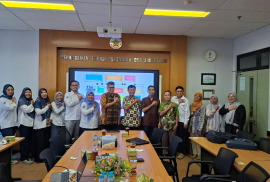
The event was attended by representatives from related agencies of the Bantul Regency Government, Sriharjo Village Head Titik Istiwayatun, Chair of the Center for Irrigation Modernization and Agriculture Studies (PK-MIP) Dr. Ansita Gupitakingkin Pradipta, Head of the Land and Water Resources Engineering Laboratory (TSLA) Dr. Hanggar Ganara Mawandha, Dr. Muhamad Khoiru Zaki, and Suyitno, S.T., M.T., Chair of the Clean Irrigation Movement (Gerakan Irigasi Bersih/GIB).

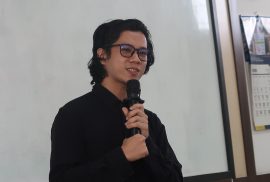
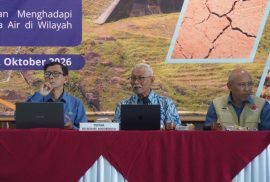
During the community discussion session, Prof. Dr. Ir. Sigit Supadmo Arif emphasized that climate change has become a real challenge requiring collective action through stronger environmental awareness rooted in Yogyakarta’s Mataraman culture.
“We are witnessing significant changes in the climate. Therefore, we need to rebuild community awareness by promoting pro-environment and pro-climate values grounded in the Mataraman cultural traditions of Yogyakarta,” he explained.
Prof. Sigit also noted that the program begins by identifying community aspirations to ensure that future activities truly reflect local needs.
“Today we are mapping the community’s aspirations so that future programs can accommodate the activities they truly need,” he added.
Representing the local community, Sugiyanto, Head of Wunut Hamlet, expressed appreciation for the collaboration that has continued for many years between DTPB FTP UGM and Sriharjo Village.
He recalled that following the 2006 Yogyakarta earthquake, Prof. Sigit and his team had assisted local farmers through training on secondary crop cultivation. Since then, agricultural practices in the village have gradually evolved from conventional surface irrigation to more efficient technologies, including hydroponic systems and irrigation hoses.
“We have been developing Srikeminut for nearly twenty years. Our dream is to integrate existing irrigation technology into an accelerated community development program while preserving our local culture and natural heritage. The terraced landscape in Sriharjo is part of our cultural heritage that deserves to be maintained,” he said.
Sriharjo Village Head Titik Istiwayatun welcomed the initiative and highlighted that environmental management efforts in the village have often been implemented separately. She hopes this new program will create stronger collaboration in addressing environmental challenges.
“We are grateful to Prof. Lilik and Prof. Gary for bringing this initiative to Sriharjo. Environmental programs in our village have often been implemented sporadically. We hope today’s discussion becomes the starting point for designing integrated strategies to address riverbank erosion, agroforestry development, and other environmental issues,” she stated.
Adding another perspective, Tantra from the Bumi Langit Institute emphasized the importance of reconnecting human beings with nature.
“The challenge is how to translate scientific knowledge into practices that no longer separate humans from nature but instead recognize them as an inseparable whole.”
Guest speaker Prof. Gary R. Sands expressed his appreciation for the opportunity to visit Sriharjo and exchange experiences with local stakeholders.
He noted that while Sriharjo is characterized by its unique karst landscape, the state of Minnesota also faces challenges in maintaining agricultural productivity under changing environmental conditions. According to him, such similarities provide valuable opportunities for mutual learning.
“Thank you for inviting me to Sriharjo. The karst landscape here is truly remarkable. Minnesota is also experiencing challenges in maintaining agricultural productivity. I hope this meeting becomes a valuable opportunity for exchanging ideas and learning from one another,” he said.
Representing the Environmental Agency of Bantul Regency, Woro encouraged local stakeholders to align community initiatives with the Climate Village Program (Program Kampung Iklim/ProKlim).
“We encourage all community activities to remain aligned with the objectives of the Climate Village Program. The Environmental Agency is fully committed to supporting Srikeminut and Sriharjo Village in implementing ProKlim,” she explained.

Ceremonial Planting of Sugar Palm Trees Along the Oyo River
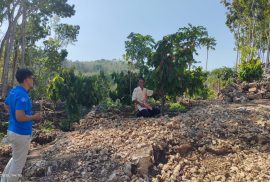
The launching ceremony concluded with the symbolic planting of sugar palm (aren) trees along the banks of the Oyo River, marking the official commencement of the Pro-Environment and Pro-Climate Village initiative. The tree-planting activity symbolizes a long-term commitment to watershed conservation, environmental restoration, and strengthening community resilience against climate change.