Yogyakarta, August 5, 2026 – Strengthening national food security requires efficient, appropriate, and research-based postharvest technology. To strengthen synergy between higher education and industry, the Department of Agricultural and Biosystems Engineering (DTPB), Faculty of Agricultural Technology, Universitas Gadjah Mada (FTP UGM), together with the Food and Postharvest Engineering Laboratory, welcomed an official visit from Perum BULOG on Wednesday (5/8).
The visit marked an initial step toward strengthening applied research collaboration between academics and Perum BULOG, particularly in optimizing agricultural processing and postharvest handling technologies. The collaboration is expected to improve postharvest processing efficiency while maintaining the quality of strategic food commodities for Indonesian communities.
Strengthening Collaboration between Academia and Perum BULOG
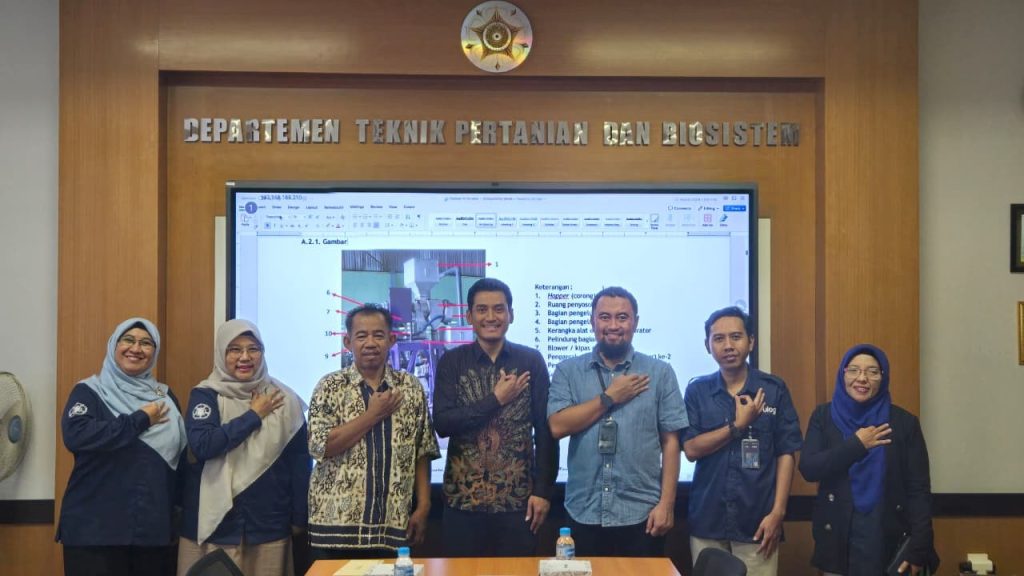
The meeting was attended by representatives of the Food and Postharvest Engineering Laboratory of DTPB FTP UGM, namely Prof. Nursigit Bintoro, Dr. Sri Rahayoe, Dr. Devi Yuni Susanti, Dr. Hanim Zuhrotul Amanah, and Dr. Arifin Dwi Saputro.
Perum BULOG was represented by Andy Nugroho, S.T.P., M.M., Head of BULOG’s Processing Division; Danang Dwi Prastyo, S.T.P., M.Sc., Processing Manager for Region I; and Mulkan Syarif, S.T.P., Assistant Manager of Processing Operations for Region I.
During the meeting, both parties discussed potential research collaborations that could bridge industrial needs with the development of knowledge and technology in higher education.
This synergy is considered important given Perum BULOG’s strategic role in managing national food commodities, while DTPB FTP UGM possesses academic expertise and laboratory facilities that can support the development and evaluation of postharvest technologies.
Optimizing Research-Based Postharvest Technology
As an institution playing a strategic role in national food management, Perum BULOG operates various postharvest processing infrastructures for rice, including Rice Milling Units (RMUs), dryers, and packing machines.
The availability of these facilities requires scientific support to ensure that the technologies are operated optimally and efficiently while maintaining the quality of agricultural products.
In this context, the Food and Postharvest Engineering Laboratory of DTPB FTP UGM has the potential to contribute through laboratory testing, agricultural product characterization, postharvest technology evaluation, and the development of research-based solutions.
The collaboration between the two institutions is expected to connect operational needs in the field with scientific approaches developed through research at the university.
Focusing on Processing Efficiency and Food Loss Reduction
One of the key areas under consideration in the planned collaboration is the optimization of postharvest technology and processing efficiency for agricultural products. The research may cover technology performance evaluation, analysis of processing yields, and efforts to reduce potential food loss.
The collaboration is also expected to address the evaluation and improvement of storage systems for major food commodities. Proper storage management is essential to maintaining commodity quality throughout storage, distribution, and delivery to consumers.
One aspect that may be further investigated is the analysis of grain and rice milling yields based on the characteristics and quality of the raw material. Such information can serve as a basis for evaluating processing efficiency and determining appropriate handling strategies.
Quality assurance during agricultural product storage and distribution will also be an important component of the planned collaboration. With laboratory-based testing and analysis, processing and storage operations can be carried out in a more measurable and controlled manner.
Connecting Research with Industrial Needs through Laboratory Facilities
The collaboration between DTPB FTP UGM and Perum BULOG also represents a concrete form of applying knowledge and technology to address industrial needs.
Through its laboratory facilities and academic expertise, DTPB FTP UGM can support the evaluation of technologies implemented in the field. The results of testing and research can subsequently serve as a basis for formulating recommendations to improve operational efficiency.
This synergy further strengthens the connection between education, research, and technology application. Knowledge developed within the academic environment can be directed toward addressing real-world challenges in food processing and management systems.
Through this collaboration, the focus is not only on technology development but also on achieving more efficient processing, reducing food losses, and improving the consistency and quality of rice supplied to Indonesian consumers.
Supporting National Food Security
The research collaboration between DTPB FTP UGM and Perum BULOG is expected to contribute to strengthening Indonesia’s postharvest and food logistics systems.
Through applied research, laboratory testing, technology evaluation, and human resource development, both institutions have opportunities to develop solutions that respond to the needs of food commodity management in Indonesia.
The collaboration also opens opportunities for further activities, including applied research, laboratory testing, postharvest technology evaluation, and capacity building for human resources.
Through synergy between academia and state-owned enterprises, DTPB FTP UGM remains committed to contributing to the development of agricultural and postharvest technologies that support efficiency, sustainability, and Indonesia’s food self-sufficiency.
The collaboration with Perum BULOG represents a strategic step toward connecting research-based innovation with real-world needs in the food sector, enabling technological developments to deliver tangible benefits for strengthening Indonesia’s national food system.