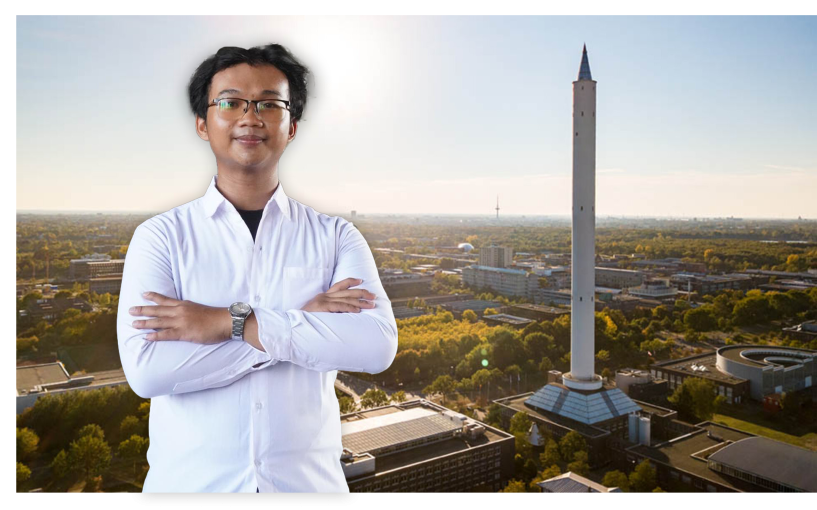
Yogyakarta, September 24, 2026 — Agricultural and Biosystems Engineering (ABE) extends far beyond addressing Earth’s agricultural challenges; it also holds significant potential for advancing space exploration technology. This was recently demonstrated by Rendy Dwi Nugraha, an undergraduate student in the Department of Agricultural and Biosystems Engineering at Universitas Gadjah Mada (FTP UGM, Class of 2024). Rendy was selected as an awardee for the prestigious 10th Drop Tower Experiment Series (DropTES), organized by the United Nations Office for Outer Space Affairs (UNOOSA).
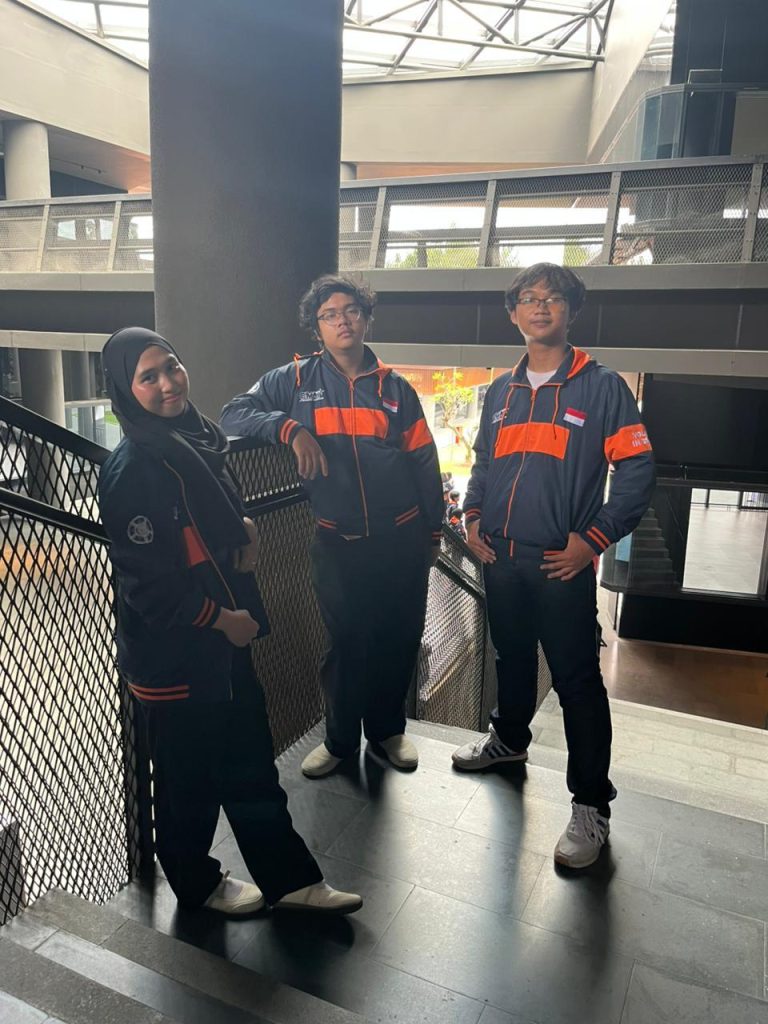
Alongside a multidisciplinary team from UGM, Rendy will investigate granular material dynamics under microgravity conditions at the Bremen Drop Tower in Germany during the first quarter of 2027. The team comprises:
-
Alessander Reynard Aritonang — Team Leader (B.Sc. Nuclear Engineering, Class of 2025)
-
Rendy Dwi Nugraha — Team Member 1 (B.Sc. Agricultural Engineering, Class of 2024)
-
Idam Sholikhah — Team Member 2 (B.A.S. Instrumentation and Control Engineering Technology, Class of 2023)
Under the DropTES initiative, the team will examine the behavior of partially wet silica sand when subjected to agitation in a microgravity environment. Designed to uncover how granular materials behave under extreme low-gravity conditions, the study aims to yield key insights for developing technologies that support future planetary and lunar exploration missions.
Navigating Technical Preparation and Critical Design Review
The program entails a rigorous preparation phase before testing begins in Germany. From August to December 2026, the team will focus on engineering, refining, and testing their experimental setup.
A crucial milestone in this phase is passing the Critical Design Review (CDR) conducted by UNOOSA and the Center of Applied Space Technology and Microgravity (ZARM). This process ensures the experimental apparatus meets stringent technical and safety standards required for microgravity testing. The final experimental campaign in Germany will span approximately two weeks in early 2027, with execution targeted for the second week of February.
The project highlights the strength of cross-disciplinary synergy. Combining expertise from Nuclear Engineering, Agricultural Engineering, and Instrumentation and Control Engineering Technology allows the team to tackle complex research requirements—spanning material characterization, mechanical apparatus design, precise instrumentation, and data acquisition.
Bridging Agricultural Science and Space Exploration
For Rendy, venturing into microgravity research initially felt like unfamiliar territory. Space research is rarely associated with traditional agricultural studies. However, participating in DropTES revealed deep interconnections between agricultural engineering principles and space exploration needs.
“Initially, I was hesitant because space research seems distant from Agricultural Engineering,” Rendy shared. “However, core ABE disciplines—such as soil mechanics, granular material behavior, and fluid dynamics—are essential for understanding growth media for future space agriculture.”
Rendy emphasized that this experience demonstrates how ABE expertise extends well beyond conventional farming on Earth. Understanding soil structures, granular dynamics, and fluid interactions provides a vital foundation for agricultural innovations in extreme extraterrestrial environments.
“This milestone proves that the boundaries of Agricultural Engineering do not stop at Earth. Our discipline is directly relevant and capable of driving meaningful contributions to space exploration,” he added.
This relevance is increasingly vital with the rise of space agriculture, an emerging field focused on optimizing growing media, moisture distribution, and controlled environments under non-Earth gravitational conditions.
Transforming Classroom Concepts into Orbit-Ready Science
Beyond conducting experiments at a world-class facility, DropTES offers an invaluable lesson in international scientific collaboration.
“Being selected for UNOOSA’s DropTES program is both an extraordinary privilege and an exciting challenge,” Rendy noted. “The most rewarding aspect isn’t just testing our apparatus at the drop tower in Germany—it’s the experience of collaborating within an international scientific framework.”
He highlighted how the initiative has deepened the team’s understanding of rigorous aerospace standards, from high-precision engineering to translating classroom theory into real-world scientific applications.
“We are learning firsthand how to meet international aerospace standards—from precision engineering to transforming academic ideas into tangible experiments that push the boundaries of space science,” Rendy added.
Global Collaboration to Drive Student Innovation
The 10th DropTES program is organized by UNOOSA under its Access to Space for All initiative, in partnership with ZARM (University of Bremen) and the German Aerospace Center (DLR). The project is supported in coordination with Indonesian diplomatic missions, including the Embassy and Permanent Mission of Indonesia (KBRI/PTRI) in Vienna.
Participation in DropTES marks a significant academic milestone for UGM, connecting Indonesian students with the global space research ecosystem. For Rendy and his teammates, the journey enhances their engineering acumen, research capabilities, and international network while adhering to global standards in microgravity testing.
Through this achievement, students from FTP UGM demonstrate that agricultural and biosystems engineering can break traditional boundaries. Mastering soil mechanics, granular dynamics, and environmental control systems lays a strong foundation for future agricultural technologies—supporting both deep-space missions and human exploration beyond Earth.