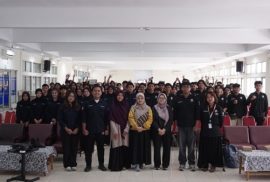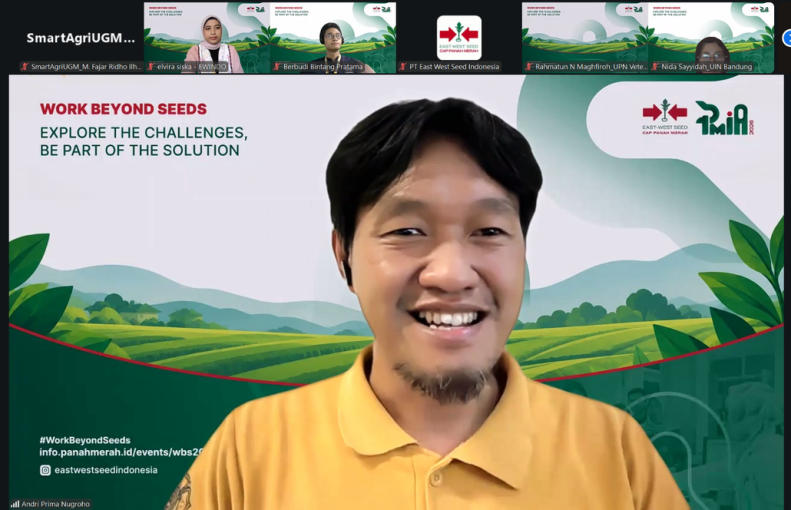
Dr. Andri served as an academic speaker representing the Department of Agricultural and Biosystems Engineering (DTPB), Faculty of Agricultural Technology, Universitas Gadjah Mada. Through the topic “Precision Farming & Sustainability”, the session aimed to introduce precision farming approaches to university students while providing foundational material for developing agricultural innovations.
During the Academic Keynote Presentation on “Precision Farming & Sustainability”, Dr. Andri highlighted the importance of linking agricultural data with cultivation decisions and field actions. Precision agriculture positions crop and environmental conditions as the foundation for determining appropriate management actions, ensuring that technology implementation serves a clear purpose in meeting agricultural management needs.

The material presented outlined the interconnected framework of measurement, analysis, decision-making, action, and evaluation. Sensors, the Internet of Things (IoT), Artificial Intelligence (AI), and automation play complementary roles within this workflow. Data collection must be followed by actionable information utilization to support water, nutrient, and crop growth environment management.

UGM’s research experiences served as practical learning cases, including the development of Smart Greenhouses and microclimate control based on Vapor Pressure Deficit (VPD). The presentation also highlighted the integration of UAV imagery and AI for oil palm tree inventorying, as well as the implementation of the SIPASI irrigation information system. These examples demonstrated the diverse agricultural management needs that can be supported by measurement, data analysis, and user assistance.
Sustainability remains a key consideration when evaluating the benefits of technology adoption. Productivity gains must be assessed alongside water, nutrient, and energy efficiency, crop quality, operational costs, and user capacity to maintain system operations. Through this approach, technology selection can be tailored to local cultivation challenges and site conditions while providing a framework for assessing impact.

The Q&A session addressed practical field challenges, ranging from smallholder farmer welfare and local knowledge integration to sensor and IoT data accuracy. Participant questions also explored digital farming opportunities for farmers currently relying on manual techniques and local seeds. This diverse discussion underscored the necessity of connecting innovation with affordability, information reliability, and actual end-user needs.


Through the PMIA 2026 program, university students are encouraged to develop agricultural innovations rooted in user challenges. Dr. Andri’s contribution to this webinar bridged academic perspectives with real-world technology implementation hurdles. This knowledge exchange is expected to equip students with the insights needed to design relevant, testable solutions that foster more efficient and sustainable agriculture.