Bogor, June 24, 2026 – Digital transformation has become one of the key strategies for achieving sustainable national food security. Supporting this vision, Dr. Andri Prima Nugroho, S.T.P., M.Eng., Ph.D., a lecturer at the Department of Agricultural and Biosystems Engineering (DTPB), Faculty of Agricultural Technology, Universitas Gadjah Mada (FTP UGM), was invited as a keynote speaker at the 8th Anniversary National Seminar of Bogor Polytechnic of Agricultural Development (Polbangtan Bogor). The seminar carried the theme “Smart Farming as a Strategy for Sustainable Food Self-Sufficiency.”
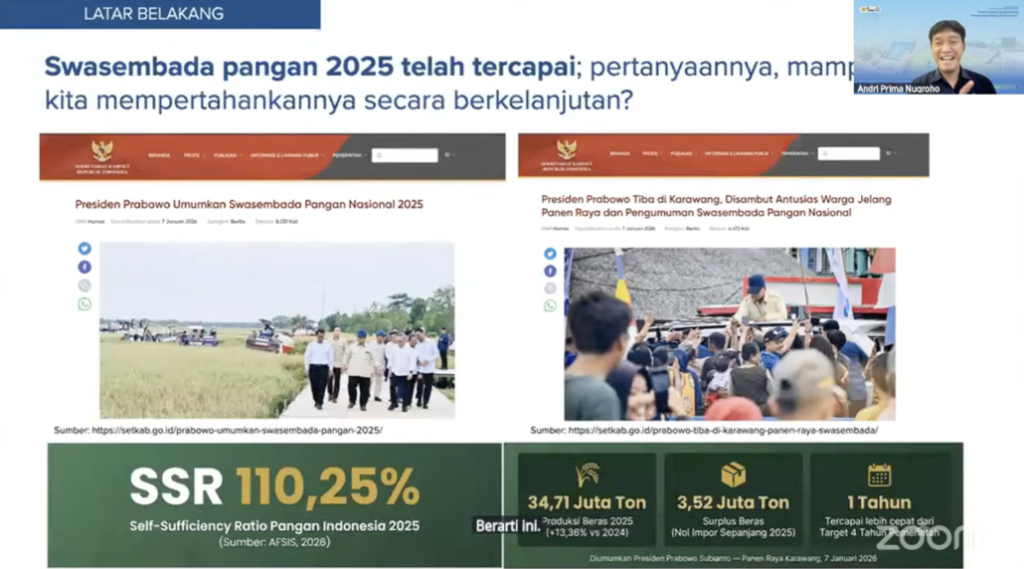
Held in a hybrid format via Zoom and YouTube, the seminar attracted more than 500 participants, including students, academics, agricultural practitioners, extension officers, and policymakers. The event served as a platform to discuss how digital technologies can strengthen sustainable agricultural development while contributing to the Sustainable Development Goals (SDGs), particularly Goal 2 (Zero Hunger) and Goal 13 (Climate Action).
In his presentation entitled “Smart Farming Innovation and Agriculture 4.0: Intelligent Agriculture as a Strategy for Sustainable Food Self-Sufficiency,” Dr. Andri emphasized that modern agriculture must embrace digital transformation to address increasingly complex challenges, including climate change, limited natural resources, and growing food demand.
He explained that Smart Farming integrates technologies such as the Internet of Things (IoT), Artificial Intelligence (AI), and big data analytics to improve production efficiency, optimize resource utilization, reduce agricultural losses, and strengthen climate resilience.
“Technology is not merely about adopting sophisticated equipment. More importantly, it empowers farmers to make better decisions based on accurate data, ultimately improving productivity while supporting sustainable agriculture,” said Dr. Andri.
During the seminar, Dr. Andri showcased several Smart Farming innovations developed at UGM, including sensor-based soil monitoring systems, precision irrigation technology, and drone-assisted agricultural mapping. These technologies have been designed to promote more efficient, data-driven, and sustainable agricultural management.
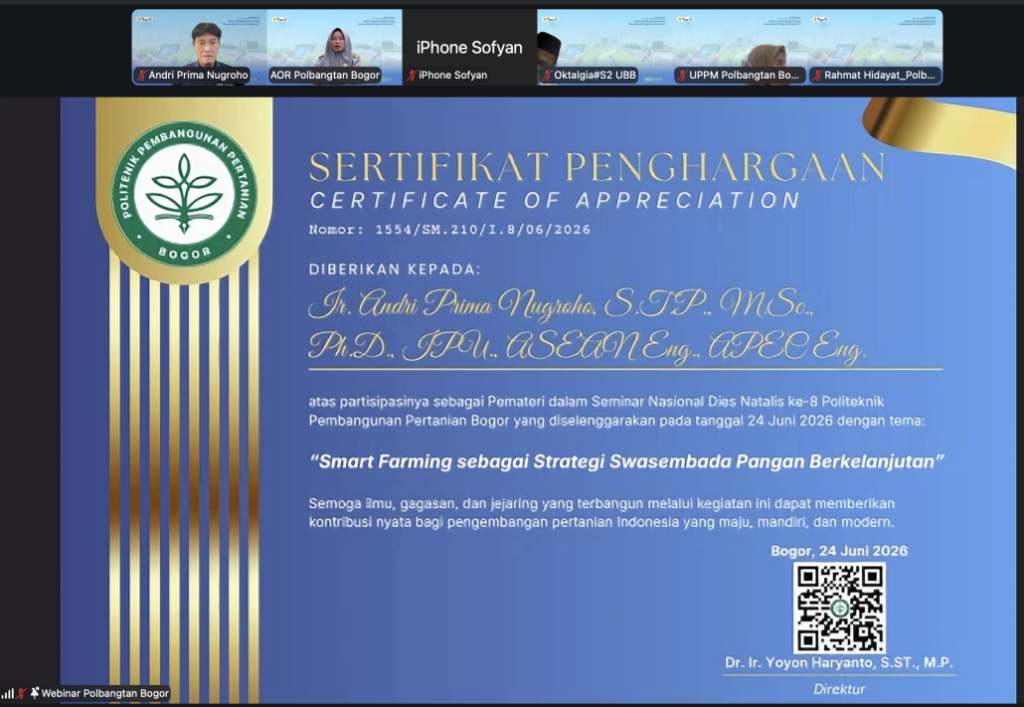
The interactive discussion session, moderated by Dr. Reni, addressed various issues raised by participants, including the challenges of implementing Smart Farming on fragmented agricultural land and integrating digital technologies with conventional farming infrastructure.
Responding to these questions, Dr. Andri highlighted that Smart Farming implementation should be introduced gradually through collaboration among universities, government institutions, farmer organizations, and industry partners.
“Digital transformation in agriculture requires more than technology alone. Strong farmer institutions, supporting infrastructure, and continuous capacity building are essential to ensure that these innovations deliver meaningful benefits,” he explained.
Dr. Andri’s participation in the national seminar reflects the commitment of the Department of Agricultural and Biosystems Engineering, FTP UGM, to advancing smart agriculture through research, innovation, and knowledge dissemination. The department continues to strengthen collaboration with academic institutions and stakeholders to accelerate the adoption of sustainable agricultural technologies across Indonesia.
“Smart Farming is one of the essential pillars for achieving sustainable food self-sufficiency. However, its success depends on the synergy between technological innovation, farmer empowerment, and supportive public policies,” Dr. Andri concluded.